 Indietro
Genetics Exam Two Key Concepts
 05:48

Termini in questo insieme (29)
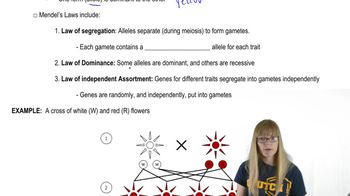
Law of Segregation: Each individual has two alleles for a gene, which segregate during gamete formation so each gamete carries only one allele.
Law of Independent Assortment: Alleles of different genes assort independently during gamete formation.
Used to predict the genotypes and phenotypes of offspring from parental crosses.
A probability tool to calculate genotype and phenotype ratios by branching possible allele combinations.
Use Punnett squares or branch diagrams to find the proportion of each genotype among offspring.
Sum genotypes that produce the same phenotype to find phenotype ratios.
Identify mode of inheritance (MOI) as autosomal or X-linked, dominant or recessive by analyzing family pedigrees.
Cell division producing two genetically identical diploid daughter cells.
Meiosis I separates homologous chromosomes (diploid to haploid), Meiosis II separates sister chromatids.
Diploid (2n): Two sets of chromosomes; Haploid (n): One set of chromosomes.
Heterozygote shows intermediate phenotype between two homozygotes.
Both alleles in heterozygote are fully expressed, producing a combined phenotype.
One gene masks or modifies the effect of another gene at a different locus.
One gene influences multiple, seemingly unrelated phenotypic traits.
Different mutations within the same gene cause similar phenotypes.
Mutations in different genes produce the same phenotype.
The proportion of individuals with a genotype who actually express the expected phenotype.
The degree or intensity of phenotype expression among individuals with the same genotype.
Sex-linked: Genes on sex chromosomes.
Sex-influenced: Autosomal genes expressed differently by sex.
Sex-limited: Traits expressed in only one sex.
Protenor: XX/XO system (e.g., some insects).
Lygaeus: XY/XX system (e.g., fruit flies).
Mammals: XY male, XX female.
Birds: ZW female, ZZ male.
Fruit flies: XY male, XX female with dosage compensation.
Visual representation of gene interactions and inheritance patterns to predict phenotypic outcomes.
Leads to somatic mosaicism with some cells having abnormal chromosome numbers.
Meiosis I: homologous chromosomes fail to separate.
Meiosis II: sister chromatids fail to separate.
Euploidy: Normal chromosome number.
Aneuploidy: Abnormal chromosome number (gain/loss).
Polyploidy: Extra complete sets of chromosomes.
Deletions remove segments; duplications repeat segments, affecting gene dosage.
Inversions reverse chromosome segments; inversion loops form during pairing in meiosis.
Reciprocal: Exchange of segments between nonhomologous chromosomes.
Robertsonian: Fusion of two acrocentric chromosomes at centromeres.
Test to determine if mutations causing similar phenotypes are in the same or different genes.