 Indietro
Genetics Key Concepts
 02:45

Termini in questo insieme (20)
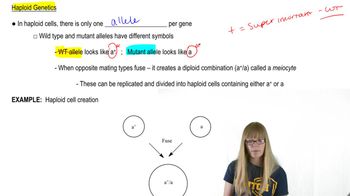
Alleles are different versions of the same gene found at the same locus on homologous chromosomes.
Crossing over is the exchange of genetic material between homologous chromosomes during meiosis, increasing genetic variation.
During metaphase, homologous chromosomes line up at the cell's equator before being separated.
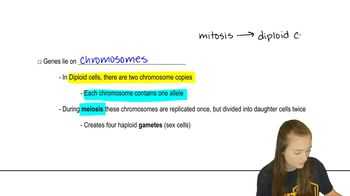
Haploid cells have one set of chromosomes (n), while diploid cells have two sets (2n).
A Punnett square predicts the possible genotypes of offspring from parental alleles.
Down syndrome is caused by trisomy 21, an extra copy of chromosome 21.
Sex-linked traits are traits associated with genes located on sex chromosomes, often the X chromosome.
DNA contains deoxyribose sugar and thymine, while RNA contains ribose sugar and uracil instead of thymine.
Mutations are changes in the DNA or RNA sequence that can affect gene function.
Homologous chromosomes carry the same genes but may have different alleles, important for genetic diversity.
Crossing over creates new allele combinations, increasing genetic diversity in gametes.
Haploid human cells have \(23\) chromosomes.
Diploid human cells have \(46\) chromosomes.
Capital letters represent dominant alleles; lowercase letters represent recessive alleles in Punnett squares.
A point mutation changes one nucleotide in the DNA or RNA sequence.
Nondisjunction is the failure of chromosomes to separate properly during meiosis, causing disorders like Down syndrome.
RNA carries genetic information from DNA to ribosomes for protein synthesis.
A genotype is the genetic makeup of an organism, the combination of alleles it carries.
A phenotype is the observable physical or biochemical characteristics of an organism resulting from its genotype.
Sex-linked disorders are often inherited through the X chromosome, affecting mostly males.