 Indietro
Mendelian Inheritance Basics
 05:48
05:48

Termini in questo insieme (20)
Mendelian inheritance refers to the patterns of inheritance for traits controlled by single genes with clear dominant and recessive alleles, as first described by Gregor Mendel.
Gregor Mendel was a 19th-century scientist who discovered the fundamental laws of inheritance through experiments with pea plants.
A gene is a unit of heredity made up of DNA that codes for a specific trait.
An allele is a variant form of a gene that can be dominant or recessive.
A dominant allele is an allele that expresses its trait even when only one copy is present.
A recessive allele only expresses its trait when two copies are present (homozygous recessive).
Genotype is the genetic makeup of an organism, referring to the combination of alleles it carries.
Phenotype is the observable physical or biochemical characteristics of an organism resulting from its genotype and environment.
Homozygous means having two identical alleles for a particular gene (e.g., AA or aa).
Heterozygous means having two different alleles for a gene (e.g., Aa).
A monohybrid cross is a genetic cross between individuals differing in one trait controlled by a single gene.
The typical phenotypic ratio is \(3:1\) dominant to recessive traits.
The genotypic ratio is \(1:2:1\) (homozygous dominant : heterozygous : homozygous recessive).
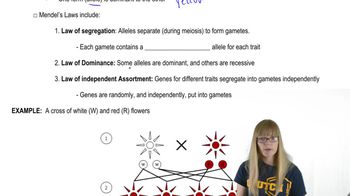
The law of segregation states that allele pairs separate during gamete formation, so each gamete carries only one allele for each gene.
The law of independent assortment states that genes for different traits assort independently during gamete formation.
A test cross is used to determine the genotype of an individual with a dominant phenotype by crossing it with a homozygous recessive individual.
A Punnett square is a diagram used to predict the genotypes and phenotypes of offspring from a genetic cross.
Autosomal dominant traits require only one copy of the dominant allele to be expressed and are located on non-sex chromosomes.
Autosomal recessive traits require two copies of the recessive allele to be expressed and are located on non-sex chromosomes.
A carrier is an individual heterozygous for a recessive trait who does not show the phenotype but can pass the allele to offspring.