Genetic variation refers to genetic differences between members of the same species, including allelic variation, chromosome mutations, and genome mutations.
What is a karyotype?
A karyotype is a cytogenetic study of chromosome structure under a microscope, used to detect extra or missing chromosomes or large structural changes.
How are chromosomes characterized?
Chromosomes are characterized by size, shape (centromere position), and banding pattern (stained dye bands).
What do the chromosome arms p and q represent?
p is the short arm and q is the long arm of a chromosome, defined by the centromere position.
What are the four main types of chromosome structural mutations?
The four main types are deletions (deficiencies), duplications, inversions, and translocations.
What is a deletion (deficiency) mutation?
A deletion results in a net loss of genetic material and can cause deleterious phenotypic changes.
How do duplications occur and what is their effect?
Duplications usually result from abnormal crossing over, often cause no phenotype or mild effects, and provide raw material for evolution.
What is the Bar eye phenotype in Drosophila an example of?
The Bar eye phenotype is an example of a gene duplication causing a visible phenotype and demonstrating the positional effect.
What is the positional effect in genetics?
The positional effect occurs when the location of a gene affects its expression and phenotype, even if gene copy number is the same.
What is a gain-of-function mutation?
A gain-of-function mutation causes a new or enhanced activity of a protein, unlike loss-of-function mutations which reduce or abolish function.
What are gene families?
Gene families are groups of similar genes derived from a common ancestral gene, often formed by gene duplications.
What are inversions and their types?
Inversions are chromosome rearrangements that do not cause net loss of genetic material; types include paracentric (not involving centromere) and pericentric (involving centromere).
How do inversions affect gamete formation?
Inversion heterozygotes form inversion loops during meiosis, which can lead to abnormal gametes due to improper crossing over.
What are translocations and their types?
Translocations involve exchange of chromosome segments without net gain or loss; types include simple and reciprocal translocations.
How do translocations affect fertility?
Translocations often cause fertility problems by disrupting chromosome pairing and segregation during meiosis.
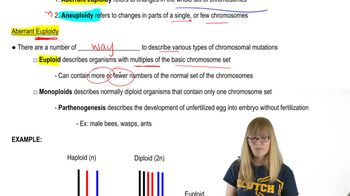
Define euploidy and examples.
Euploidy is having chromosomes in exact multiples of a set (n), e.g., haploid (1n), diploid (2n), triploid (3n), tetraploid (4n).
What is aneuploidy?
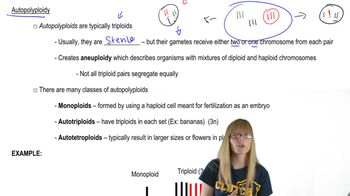
Aneuploidy is having an abnormal number of chromosomes, not a complete set, such as trisomy (extra chromosome) or monosomy (missing chromosome).
Why is trisomy or monosomy usually detrimental?
Because gene expression is imbalanced, leading to too much or too little protein production, causing developmental and health issues.
What causes aneuploidy?
Aneuploidy is caused by nondisjunction during meiosis I or II, or mitosis, leading to incorrect chromosome segregation.
What is autopolyploidy?
Autopolyploidy is having extra sets of chromosomes from the same species, e.g., tetraploid with four copies of each chromosome.
What is alloploidy and allopolyploidy?
Alloploidy has one set of chromosomes from two species; allopolyploidy has two or more complete sets from two species, often fertile if even-numbered sets.
Why are alloploids often sterile?
Because chromosomes from different species often lack homologues, preventing proper pairing and haploid gamete formation during meiosis.
Give examples of sterile and fertile hybrids.
The mule (horse x donkey) is sterile; the beefalo (bovine x buffalo) is fertile due to chromosome compatibility.
 Indietro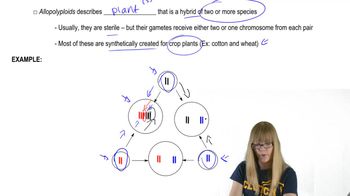
 04:34
04:34