Ch. 2 - Mitosis and Meiosis
Klug - Essentials of Genetics 10th Edition
Klug10th EditionEssentials of GeneticsISBN: 9780135588789Non è quello che usi tu?Cambia libro di testo
Capitolo 2, Problema 4

Discuss the concepts of homologous chromosomes, diploidy, and haploidy. What characteristics do two homologous chromosomes share?

Guida verificata passo dopo passo
1
Start by defining homologous chromosomes: these are pairs of chromosomes in a diploid organism that have the same length, centromere position, and carry genes for the same traits at corresponding loci, but may have different alleles.
Explain diploidy as the state of having two complete sets of chromosomes, one set inherited from each parent, which means each chromosome has a homologous partner.
Describe haploidy as having only one complete set of chromosomes, typical of gametes (sperm and egg cells), which contain only one chromosome from each homologous pair.
Discuss the shared characteristics of homologous chromosomes, emphasizing that they have the same gene sequence and structure, but can differ in the specific versions (alleles) of those genes they carry.
Summarize by highlighting that homologous chromosomes pair during meiosis, allowing for genetic recombination and proper segregation, which is fundamental to sexual reproduction and genetic diversity.

Risposta video verificata per un problema simile:

Questa soluzione video è stata consigliata dai nostri tutor come utile per risolvere questo problema.
Durata del video:
3m

Concetti chiave

Ecco i concetti essenziali che devi comprendere per rispondere correttamente alla domanda.

Homologous Chromosomes

Homologous chromosomes are pairs of chromosomes in a diploid organism that have the same length, shape, and gene sequence. One chromosome of each pair is inherited from each parent. They carry the same genes at corresponding loci but may have different alleles, which contributes to genetic variation.
Video consigliato:
Percorso guidato
07:10
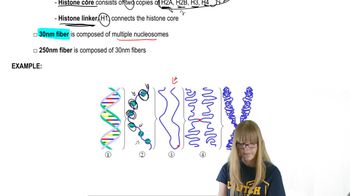
Chromosome Structure

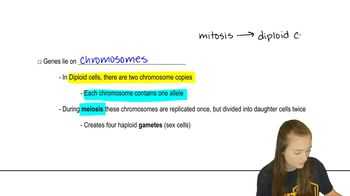
Diploidy

Diploidy refers to cells that contain two complete sets of chromosomes, one from each parent. In diploid organisms, chromosomes exist in homologous pairs, allowing for genetic recombination during meiosis. Most somatic cells in animals and plants are diploid.
Video consigliato:
Percorso guidato
27:36
Diploid Genetics

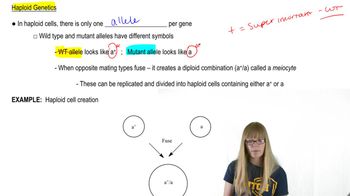
Haploidy

Haploidy describes cells that have only one set of chromosomes, such as gametes (sperm and egg cells). Haploid cells are produced through meiosis and combine during fertilization to restore diploidy. This ensures genetic diversity and proper chromosome number across generations.
Video consigliato:
Percorso guidato
02:45
Haploid Genetics