Ch. 5 - Sex Determination and Sex Chromosomes
Klug - Essentials of Genetics 10th Edition
Klug10th EditionEssentials of GeneticsISBN: 9780135588789Non è quello che usi tu?Cambia libro di testo
Capitolo 5, Problema 23

In mice, the Sry gene is located on the Y chromosome very close to one of the pseudoautosomal regions that pairs with the X chromosome during male meiosis. Given this information, propose a model to explain the generation of unusual males who have two X chromosomes (with an Sry-containing piece of the Y chromosome attached to one X chromosome).

Guida verificata passo dopo passo
1
Understand that the Sry gene is normally located on the Y chromosome and is critical for male sex determination in mice.
Recognize that the pseudoautosomal regions (PARs) on the X and Y chromosomes allow pairing and recombination during male meiosis.
Propose that an abnormal crossover event occurs between the Y chromosome region containing the Sry gene and the X chromosome within or near the pseudoautosomal region during meiosis.
Explain that this crossover transfers the Sry-containing segment from the Y chromosome onto one of the X chromosomes, resulting in an X chromosome carrying Sry.
Conclude that fertilization involving this X chromosome with Sry can produce males with two X chromosomes, one of which carries the Sry gene, leading to male development despite the absence of a full Y chromosome.

Risposta video verificata per un problema simile:

Questa soluzione video è stata consigliata dai nostri tutor come utile per risolvere questo problema.
Durata del video:
3m

Concetti chiave

Ecco i concetti essenziali che devi comprendere per rispondere correttamente alla domanda.

Pseudoautosomal Regions and Chromosome Pairing

Pseudoautosomal regions (PARs) are homologous segments found at the ends of the X and Y chromosomes that allow them to pair and recombine during male meiosis. This pairing is essential for proper segregation of sex chromosomes. Because the Sry gene is near a PAR, it can be involved in recombination events that transfer Y chromosome segments to the X chromosome.
Video consigliato:
Percorso guidato
00:30
Regions of X Chromosomes

Sry Gene and Sex Determination

The Sry gene is the primary sex-determining gene on the Y chromosome that initiates male development by triggering testis formation. Its presence typically leads to male phenotypes, even if the individual has two X chromosomes, as Sry expression overrides the default female developmental pathway.
Video consigliato:
Percorso guidato
04:24
Sex Determination

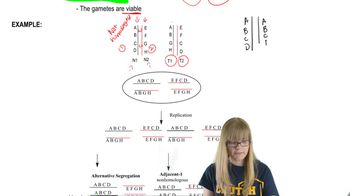
Chromosomal Translocation and Unusual Karyotypes

Chromosomal translocation involves the transfer of a chromosome segment to a non-homologous chromosome. In this case, a piece of the Y chromosome containing Sry can become attached to an X chromosome during meiosis, producing XX individuals with male characteristics. This explains the presence of males with two X chromosomes but carrying the Sry gene.
Video consigliato:
Percorso guidato
12:42
Reciprocal Translocation
Pratica correlata
Domanda del libro di testo

Cat breeders are aware that kittens expressing the X-linked calico coat pattern and tortoiseshell pattern are almost invariably females. Why are they certain of this?

493
views
Domanda del libro di testo

Predict the potential effect of the Lyon hypothesis on the retina of a human female heterozygous for the X-linked red-green color blindness trait.

685
views
Domanda del libro di testo

In mice, the X-linked dominant mutation Testicular feminization (Tfm) eliminates the normal response to the testicular hormone testosterone during sexual differentiation. An XY mouse bearing the Tfm allele on the X chromosome develops testes, but no further male differentiation occurs—the external genitalia of such an animal are female. From this information, what might you conclude about the role of the Tfm gene product and the X and Y chromosomes in sex determination and sexual differentiation in mammals? Can you devise an experiment, assuming you can 'genetically engineer' the chromosomes of mice, to test and confirm your explanation?

748
views
Domanda del libro di testo

In chickens, a key gene involved in sex determination has recently been identified. Called DMRT1, it is located on the Z chromosome and is absent on the W chromosome. Like SRY in humans, it is male determining. Unlike SRY in humans, however, female chickens (ZW) have a single copy while males (ZZ) have two copies of the gene. Nevertheless, it is transcribed only in the developing testis. Working in the laboratory of Andrew Sinclair (a co-discoverer of the human SRY gene), Craig Smith and colleagues were able to 'knock down' expression of DMRT1 in ZZ embryos using RNA interference techniques. In such cases, the developing gonads look more like ovaries than testes. What conclusions can you draw about the role that the DMRT1 gene plays in chickens in contrast to the role the SRY gene plays in humans?

880
views
Domanda del libro di testo

The genes encoding the red- and green-color-detecting proteins of the human eye are located next to one another on the X chromosome and probably evolved from a common ancestral pigment gene. The two proteins demonstrate 76 percent homology in their amino acid sequences. A normal-visioned woman (with both genes present on each of her two X chromosomes) has a red-color-blind son who was shown to have one copy of the green-detecting gene and no copies of the red-detecting gene. Devise an explanation for these observations at the chromosomal level (involving meiosis).

597
views