Ch. 8 - Chromosome Mutations: Variation in Number and Arrangement
Klug - Concepts of Genetics 12th Edition
Klug12th EditionConcepts of GeneticsISBN: 9780135564776Non è quello che usi tu?Cambia libro di testo
Capitolo 8, Problema 7

Contrast the fertility of an allotetraploid with an autotriploid and an autotetraploid.

Guida verificata passo dopo passo
1
Step 1: Define the terms to understand the types of polyploids involved. An allotetraploid has two different sets of chromosomes from two different species (2n from species A + 2n from species B), an autotriploid has three sets of chromosomes all from the same species (3n), and an autotetraploid has four sets of chromosomes all from the same species (4n).
Step 2: Consider how chromosome pairing occurs during meiosis in each type. In an allotetraploid, homologous chromosomes from each species pair properly because they come in sets of two, allowing for regular bivalent formation.
Step 3: Analyze the autotriploid situation. With three sets of chromosomes, homologous chromosomes cannot pair evenly during meiosis, leading to unbalanced gametes and reduced fertility.
Step 4: Examine the autotetraploid case. Since there are four homologous chromosomes from the same species, pairing can occur as multivalents or bivalents, which can lead to some irregular segregation but generally better fertility than triploids.
Step 5: Summarize the fertility outcomes based on chromosome pairing and segregation: allotetraploids tend to have high fertility due to stable bivalent pairing, autotriploids have low fertility due to irregular segregation, and autotetraploids have intermediate to high fertility depending on how chromosomes pair during meiosis.

Risposta video verificata per un problema simile:

Questa soluzione video è stata consigliata dai nostri tutor come utile per risolvere questo problema.
Durata del video:
2m

Concetti chiave

Ecco i concetti essenziali che devi comprendere per rispondere correttamente alla domanda.

Polyploidy and Types of Polyploids

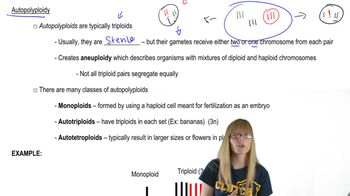
Polyploidy refers to organisms having more than two sets of chromosomes. Autopolyploids arise from chromosome duplication within a single species, while allopolyploids result from hybridization between different species followed by chromosome doubling. Understanding these distinctions is crucial for comparing fertility among different polyploid types.
Video consigliato:
Percorso guidato
00:36
Types of Maternal Inheritance

Chromosome Pairing and Meiosis in Polyploids

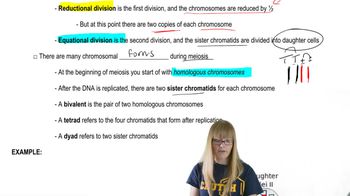
Fertility in polyploids depends on proper chromosome pairing during meiosis. Autopolyploids often have multivalent pairing due to homologous chromosomes, leading to irregular segregation and reduced fertility. Allopolyploids typically form bivalents because their chromosomes come from different species, promoting regular meiosis and higher fertility.
Video consigliato:
Percorso guidato
05:30
Meiosis Overview

Fertility Differences Among Autotriploids, Autotetraploids, and Allotetraploids

Autotriploids usually have low fertility due to unbalanced gametes from uneven chromosome segregation. Autotetraploids may have moderate fertility but can suffer from multivalent formation causing some meiotic irregularities. Allotetraploids generally exhibit higher fertility because their chromosomes pair as homologous sets, ensuring balanced gametes.
Video consigliato: