Ch. 11 - Gene Mutation, DNA Repair, and Homologous Recombination
Sanders - Genetic Analysis: An Integrated Approach 3rd Edition
Sanders3rd EditionGenetic Analysis: An Integrated ApproachISBN: 9780135564172Non è quello che usi tu?Cambia libro di testo
Capitolo 11, Problema 13e

Answer the following questions concerning the accuracy of DNA polymerase during replication.
If the kind of abnormality identified in part (c) is not corrected before the next DNA replication cycle, what kind of mutation occurs?

Guida verificata passo dopo passo
1
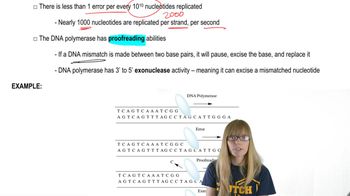
Understand the role of DNA polymerase in replication: DNA polymerase is responsible for synthesizing new DNA strands by adding nucleotides complementary to the template strand. It has proofreading activity to correct errors during replication.
Recognize the abnormality mentioned in part (c): This likely refers to a mismatch or error in the DNA sequence that DNA polymerase failed to correct during replication.
Consider the consequences of uncorrected errors: If the mismatch is not repaired before the next replication cycle, the error becomes permanent in the DNA sequence, leading to a mutation.
Identify the type of mutation: The mutation depends on the nature of the mismatch. For example, if an incorrect base is incorporated and not corrected, it can result in a point mutation, such as a transition (purine to purine or pyrimidine to pyrimidine) or transversion (purine to pyrimidine or vice versa).
Understand the implications: Mutations can alter the genetic code, potentially affecting protein function or regulation. Some mutations may be silent, while others can lead to significant phenotypic changes or diseases.

Risposta video verificata per un problema simile:

Questa soluzione video è stata consigliata dai nostri tutor come utile per risolvere questo problema.
Durata del video:
2m

Concetti chiave

Ecco i concetti essenziali che devi comprendere per rispondere correttamente alla domanda.

DNA Polymerase Function

DNA polymerase is an enzyme responsible for synthesizing new DNA strands by adding nucleotides complementary to the template strand during DNA replication. Its accuracy is crucial for maintaining genetic fidelity, as it also possesses proofreading abilities to correct errors that occur during nucleotide incorporation.
Video consigliato:
Percorso guidato
08:26
Functional Genomics

Types of Mutations

Mutations are changes in the DNA sequence that can occur due to errors in replication, environmental factors, or spontaneous changes. They can be classified into several types, including point mutations (single nucleotide changes), insertions, deletions, and larger chromosomal alterations, each with different implications for gene function and organismal traits.
Video consigliato:
Percorso guidato
10:48
Mutations and Phenotypes

Consequences of Uncorrected Errors

If abnormalities in DNA replication are not corrected, they can lead to permanent mutations in the DNA sequence. These mutations can affect gene expression and protein function, potentially resulting in diseases, developmental issues, or increased susceptibility to certain conditions, depending on the nature and location of the mutation.
Video consigliato:
Pratica correlata
Domanda del libro di testo

Several types of mutation are identified and described in the chapter. These include (1) promoter mutation, (2) splice site mutation, (3) missense mutation, (4) frameshift mutation, and 5) nonsense mutation. Match the following mutation descriptions with the type(s) of mutations listed above. More than one mutation type might match a description.


A mutation that produces about 5% of the wild-type amount of an mRNA.

563
views
Domanda del libro di testo

Answer the following questions concerning the accuracy of DNA polymerase during replication.

If a DNA replication error is detected by DNA polymerase, how is it corrected?

419
views
Domanda del libro di testo

Answer the following questions concerning the accuracy of DNA polymerase during replication.

If a replication error escapes detection and correction, what kind of abnormality is most likely to exist at the site of the replication error?

438
views
Domanda del libro di testo

Answer the following questions concerning the accuracy of DNA polymerase during replication.

Identify two mechanisms that can correct the kind of abnormality resulting from the circumstances identified in part (c).

454
views
Domanda del libro di testo

Several types of mutation are identified and described. These include (1) promoter mutation, (2) splice site mutation, (3) missense mutation, (4) frameshift mutation, and 5) nonsense mutation. Match the following mutation descriptions with the type(s) of mutations listed above. More than one mutation type might match a description.


A mutation that changes several amino acids in a protein and results in a protein that is shorter than the wild-type product.

849
views
Domanda del libro di testo

Answer the following questions concerning the accuracy of DNA polymerase during replication.

DNA mismatch repair can accurately distinguish between the template strand and the newly replicated strand of a DNA duplex. What characteristic of DNA strands is used to make this distinction?

458
views