Ch. 17 - Organelle Inheritance and the Evolution of Organelle Genomes
Sanders - Genetic Analysis: An Integrated Approach 3rd Edition
Sanders3rd EditionGenetic Analysis: An Integrated ApproachISBN: 9780135564172Non è quello che usi tu?Cambia libro di testo
Capitolo 17, Problema 17

The first person in a family to exhibit Leber hereditary optic neuropathy (LHON) was II-3 in the pedigree shown below, and all of her children also exhibited the disease. Provide two possible explanations as to why II-3's mother (I-1) did not exhibit symptoms of LHON.
Pedigree chart showing family history of Leber hereditary optic neuropathy with affected individuals.

Guida verificata passo dopo passo
1
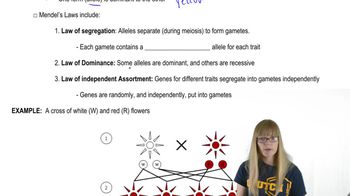
Identify that Leber hereditary optic neuropathy (LHON) is a mitochondrial disorder, which means it is passed through the maternal line.
Observe that individual II-3 is affected and all her children (III-1, III-2, III-3) are also affected, indicating maternal inheritance.
Consider that I-1, the mother of II-3, might not exhibit symptoms due to heteroplasmy, where a mixture of normal and mutated mitochondria exists, and the proportion of mutated mitochondria is not sufficient to cause symptoms.
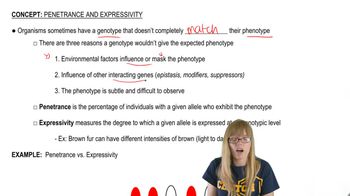
Another possibility is that I-1 has a lower penetrance of the disease, meaning she carries the mutation but does not express the symptoms due to other genetic or environmental factors.
Conclude that the absence of symptoms in I-1 does not preclude her from being a carrier of the mitochondrial mutation responsible for LHON.

Risposta video verificata per un problema simile:

Questa soluzione video è stata consigliata dai nostri tutor come utile per risolvere questo problema.
Durata del video:
2m

Concetti chiave

Ecco i concetti essenziali che devi comprendere per rispondere correttamente alla domanda.

Leber Hereditary Optic Neuropathy (LHON)

LHON is a mitochondrial genetic disorder that primarily affects the optic nerve, leading to vision loss. It is caused by mutations in mitochondrial DNA, which is inherited maternally. The disease typically manifests in young adults, and while it can affect both genders, males are more frequently affected. Understanding LHON's inheritance pattern is crucial for analyzing family pedigrees.
Video consigliato:

Mitochondrial Inheritance

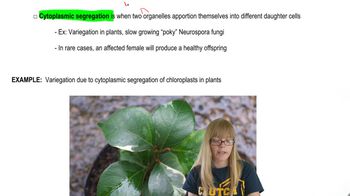
Mitochondrial inheritance refers to the transmission of genetic traits through mitochondrial DNA, which is passed from mothers to all their offspring. This type of inheritance explains why II-3's children exhibit LHON, as they inherit the affected mitochondrial DNA from their mother. However, it also clarifies why II-3's mother (I-1) may not show symptoms, as not all individuals with mitochondrial mutations express the disease due to factors like variable expressivity.
Video consigliato:
Percorso guidato
05:13
Organelle Inheritance

Variable Expressivity

Variable expressivity is a phenomenon where individuals with the same genetic mutation exhibit different degrees of severity or even different symptoms of a disease. In the context of LHON, I-1 may carry the mutation but not express the disease due to factors such as environmental influences, other genetic factors, or the specific nature of the mutation. This concept is essential for understanding why some family members may be asymptomatic despite carrying the same genetic risk.
Video consigliato:
Percorso guidato
02:09
Penetrance and Expressivity
Pratica correlata
Domanda del libro di testo

A 50-year-old man has been diagnosed with MELAS syndrome. His wife is phenotypically normal, and there is no history of MELAS syndrome in either of their families. The couple is concerned about whether their children will develop the disease. As a genetic counselor, what will you tell them? Would your answer change if it were the mother who exhibited disease symptoms rather than the father?

414
views
Domanda del libro di testo

You have isolated two petite mutants, pet1 and pet2, in Saccharomyces cerevisiae. When pet1 is mated with wild-type yeast, the haploid products following meiosis segregate 2:2 (wild type : petite). In contrast, when pet2 is mated with wild type, all haploid products following meiosis are wild type. To what class of petite mutations does each of these petite mutants belong? What types of progeny do you expect from a pet1 × pet2 mating?

374
views
Domanda del libro di testo

Consider this human pedigree for a vision defect.

What is the most probable mode of inheritance of the disease? Identify any discrepancies between the pedigree and your proposed mode of transmission, and provide possible explanations for these exceptions. 

512
views
Domanda del libro di testo

In 1918, the Russian tsar Nicholas II was deposed, and he and his family were reportedly executed and buried in a shallow grave. During this chaotic time, rumors abounded that the youngest daughter, Anastasia, had escaped. In 1920, a woman in Germany claimed to be Anastasia. In 1979, remains were recovered for the tsar, his wife (the Tsarina Alexandra), and three of their children, but not Anastasia. How would you evaluate the claim of the woman in Germany?

417
views
Domanda del libro di testo

What is the most likely mode of inheritance for the trait depicted in the following human pedigree? 

1003
views
Domanda del libro di testo

The following pedigree shows a family in which several individuals exhibit symptoms of the mitochondrial disease MERRF. Two siblings (II-2 and II-5) approach you to inquire about whether their children will also be afflicted with MERRF. What do you tell them? 

1092
views