Ch. 3 - Cell Division and Chromosome Heredity
Sanders - Genetic Analysis: An Integrated Approach 3rd Edition
Sanders3rd EditionGenetic Analysis: An Integrated ApproachISBN: 9780135564172Non è quello che usi tu?Cambia libro di testo
Capitolo 3, Problema C.3d

For the retinal cancer retinoblastoma, the inheritance of one mutated copy of RB1 from one of the parents is often referred to as a mutation that produces a 'dominant predisposition to cancer.' This means that the first mutation does not produce cancer but makes it very likely that cancer will develop.


What is the genotype of a normal cell in the retina in a person who has sporadic retinoblastoma? What is the normal cell genotype if the person has hereditary retinoblastoma? Explain the reason for the difference between the genotypes.

Guida verificata passo dopo passo
1
Understand that retinoblastoma involves mutations in the RB1 gene, which is a tumor suppressor gene. Cancer develops when both copies of RB1 in a retinal cell are inactivated (the 'two-hit hypothesis').
For sporadic retinoblastoma, both mutations occur in retinal cells after conception (somatic mutations). Therefore, the normal retinal cells in this person have two normal RB1 alleles (genotype: RB1+/RB1+), and cancer arises only after two somatic mutations in the same cell.
For hereditary retinoblastoma, the person inherits one mutated RB1 allele from a parent (germline mutation). Thus, all cells, including normal retinal cells, have one mutated and one normal RB1 allele (genotype: RB1+/RB1-).
The difference in genotype arises because hereditary retinoblastoma involves a germline mutation present in every cell, predisposing cells to cancer with only one additional somatic mutation, whereas sporadic retinoblastoma requires two somatic mutations in the same cell to develop cancer.
Summarize that the key concept is the difference between germline (hereditary) and somatic (sporadic) mutations, which explains why normal retinal cells have different genotypes in these two forms of retinoblastoma.

Risposta video verificata per un problema simile:

Questa soluzione video è stata consigliata dai nostri tutor come utile per risolvere questo problema.
Durata del video:
1m

Concetti chiave

Ecco i concetti essenziali che devi comprendere per rispondere correttamente alla domanda.

Two-Hit Hypothesis

The two-hit hypothesis explains that both copies of a tumor suppressor gene, like RB1, must be inactivated for cancer to develop. In hereditary retinoblastoma, one mutated copy is inherited (first hit), and a second mutation occurs somatically (second hit). In sporadic cases, both mutations happen in the same retinal cell during the person's life.
Video consigliato:
Percorso guidato
03:13
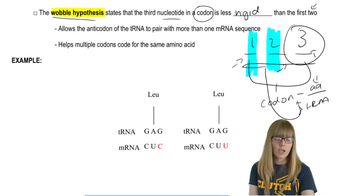
Translation:Wobble Hypothesis

Genotype Differences in Hereditary vs. Sporadic Retinoblastoma

In hereditary retinoblastoma, normal retinal cells carry one mutated RB1 allele and one normal allele, predisposing them to cancer after a second mutation. In sporadic retinoblastoma, normal retinal cells have two normal RB1 alleles initially, and cancer arises only after both alleles acquire mutations in the same cell.
Video consigliato:
Percorso guidato
04:46
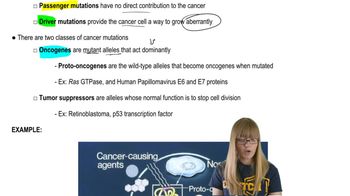
Cancer Mutations

Role of Tumor Suppressor Genes in Cancer

Tumor suppressor genes like RB1 regulate cell growth and prevent tumor formation. Mutations that inactivate both gene copies remove this control, leading to uncontrolled cell division and cancer. Understanding this helps explain why one inherited mutation increases cancer risk but does not cause cancer alone.
Video consigliato:
Percorso guidato
04:46
Cancer Mutations
Pratica correlata
Domanda del libro di testo

The diploid number of the hypothetical animal Geneticus introductus is 2n = 36. Each diploid nucleus contains 3 ng of DNA in G₁.

What amount of DNA is contained in each nucleus at the end of the S phase?

463
views
Domanda del libro di testo

Cohesion between sister chromatids, as well as tension created by the pull of kinetochore microtubules, is essential to ensure efficient separation of chromatids at mitotic anaphase or in meiotic anaphase II. Explain why sister chromatid cohesion is important, and discuss the role of the proteins cohesin and separase in sister chromatid separation.

714
views
Domanda del libro di testo

The diploid number of the hypothetical animal Geneticus introductus is 2n = 36. Each diploid nucleus contains 3 ng of DNA in G₁.

Explain why a somatic cell of Geneticus introductus has the same number of chromosomes and the same amount of DNA at the beginning of mitotic prophase as one of these cells does at the beginning of prophase I of meiosis.

576
views
Domanda del libro di testo

For the retinal cancer retinoblastoma, the inheritance of one mutated copy of RB1 from one of the parents is often referred to as a mutation that produces a 'dominant predisposition to cancer.' This means that the first mutation does not produce cancer but makes it very likely that cancer will develop.

Using RB1⁺ for the normal wild-type allele and RB1⁻ for the mutant allele, identify the genotype of a cell in a retinoblastoma tumor.

459
views
Domanda del libro di testo

In a test of his chromosome theory of heredity, Morgan crossed a female Drosophila with red eyes to a male with white eyes. The females were produced from Cross A, shown in the Figure below. Predict the offspring Morgan would have expected under his hypothesis that the gene for eye color is on the X chromosome in fruit flies.

572
views
Domanda del libro di testo

Our closest primate relative, the chimpanzee, has a diploid number of 2n = 48. For each of the following stages of M phase, identify the number of chromosomes present in each cell.

Early prophase I

405
views