Indietro

GOB Chemistry: Carbohydrate Metabolism

I pulsanti di controllo sono stati cambiati in modalità "navigazione".
1/20
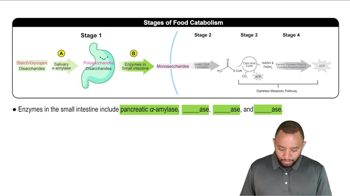
  • Where are carbohydrates digested in Stage 1 of catabolism?

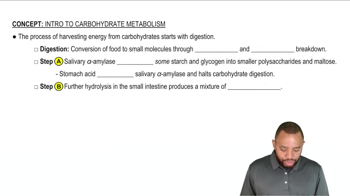
    Carbohydrates are digested in the mouth (salivary α-amylase), stomach, and small intestine (pancreatic α-amylase), with absorption through the small intestines.
  • Define glycolysis.

    Glycolysis is the breakdown of glucose into two molecules of pyruvate while producing energy.
  • Define gluconeogenesis.

    Gluconeogenesis is the synthesis of glucose from amino acids, pyruvate, and non-carbohydrates.
  • Define glycogenesis.

    Glycogenesis is the synthesis of glycogen from glucose.
  • Define glycogenolysis.

    Glycogenolysis is the breakdown of glycogen to glucose.
  • What is the purpose of the pentose phosphate pathway?

    The pentose phosphate pathway converts glucose to five-carbon sugar phosphates used in nucleic acid synthesis and lipid biosynthesis.
  • What is the main purpose of glycolysis?

    To convert glucose to two molecules of pyruvate while producing energy in the form of ATP and NADH.
  • Which steps in glycolysis use ATP?

    Steps 1 (hexokinase) and 3 (phosphofructokinase) use ATP to phosphorylate glucose and fructose-6-phosphate.
  • Which steps in glycolysis produce ATP?

    Steps 7 (phosphoglycerate kinase) and 10 (pyruvate kinase) produce ATP via substrate-level phosphorylation.
  • Which step in glycolysis produces reduced coenzymes?

    Step 6 (glyceraldehyde 3-phosphate dehydrogenase) produces NADH.
  • Why is the phosphorylation of glucose important in glycolysis?

    Phosphorylation traps glucose inside the cell and activates it by making it a high-energy molecule.
  • Why is the conversion of fructose-6-phosphate to fructose-1,6-bisphosphate highly regulated?

    It is the committed step of glycolysis, highly exergonic, and irreversible, controlled by allosteric regulators like ATP and AMP.
  • What happens to pyruvate during anaerobic respiration?

    Pyruvate is converted to lactate to regenerate NAD+ for glycolysis to continue.
  • What happens to pyruvate during aerobic respiration?

    Pyruvate is converted to acetyl-CoA, which enters the citric acid cycle for further oxidation.
  • Why do red blood cells metabolize glucose anaerobically?

    RBCs lack mitochondria, so they convert pyruvate to lactate to regenerate NAD+ and produce ATP anaerobically.
  • What is the overall reaction of glycolysis?

    Glucose + 2 NAD+ + 2 HOPO32- + 2 ADP → 2 pyruvate + 2 NADH + 2 ATP + 2 H2O.
  • Name the six major enzyme classifications involved in glycolysis.

    Enzymes include kinases, isomerases, aldolases, dehydrogenases, mutases, and enolases.
  • What is the fate of pyruvate in yeast fermentation?

    Pyruvate is converted to ethanol and CO2 under anaerobic conditions.
  • What is the role of phosphofructokinase in glycolysis?

    It catalyzes the phosphorylation of fructose-6-phosphate to fructose-1,6-bisphosphate and is a major regulatory step.
  • Why is pyruvate considered more oxidized than glucose?

    Because each carbon in pyruvate has more covalent bonds to oxygen than in glucose.