 Indietro
GOB Chemistry: Carbohydrates
 1:29

Termini in questo insieme (20)
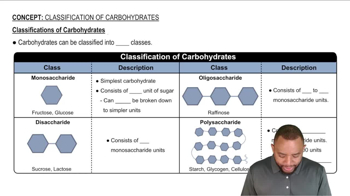
A monosaccharide is a carbohydrate that cannot be hydrolyzed into smaller sugars and contains 3-7 carbons.
An aldose contains an aldehyde group; a ketose contains a ketone group.
D & L isomers (enantiomers), diastereomers, and anomers.
Enantiomers that are mirror images; D form has the -OH on the last chiral carbon on the right, L form on the left.
Stereoisomers that are not mirror images, differing in configuration at one or more chiral centers.
Cyclic sugars differing in the position of the substituent at the hemiacetal (anomeric) carbon, alpha or beta forms.
If the -OH on the anomeric carbon is below the ring, it is alpha; if above, it is beta.
If anomeric carbon is bonded with a OH then it is a reducing sugar that can be oxidized, e.g., glucose.
Its anomeric carbons are involved in glycosidic bonds, so no free hemiacetal group is available.
A bond between the anomeric carbon of a sugar and an -OR group, forming acetals or glycosides.
By the configuration of the anomeric carbon involved in the bond.
Maltose (glucose-glucose), lactose (galactose-glucose), and sucrose (glucose-fructose).
Maltose: α-1,4; Lactose: β-1,4; Sucrose: α-1,β-2 linkage.
Sucralose resembles sucrose.
Aspartame is made from amino acids.
Sugar feeds bacteria like S. mutans, which produce acid that lowers pH and dissolves tooth enamel.
Energy source, metabolic intermediates, anticoagulants, joint lubricants, cell surface receptors, and blood type determinants.
Type O lacks A and B carbohydrate antigens on red blood cells, so it is not attacked by recipient antibodies.
Glycogen and starch have α-1,4 and α-1,6 linkages (branched), cellulose has β-1,4 linkages (linear).
Humans can digest glycogen and starch but not cellulose due to lack of β-1,4 glycosidase enzymes.