 Indietro
GOB Chemistry: Electronegativity, Bond Polarity, Molecular Polarity & Intermolecular Forces
 06:36
06:36
Termini in questo insieme (20)
Electronegativity is the ability of an atom to attract and share electron pairs in a chemical bond.
Electronegativity increases from left to right across a period and from bottom to top in a group.
Fluorine has the highest electronegativity value of \(4.0\), making it the strongest atom at attracting electrons.
Atoms share electrons equally with a ΔEN between 0 and 0.4, e.g., Cl–Cl or C–H bonds.
Electrons are shared unequally due to a ΔEN between 0.5 and 1.8, causing partial charges (δ+ and δ−) on atoms.
Electrons are essentially transferred between atoms with a ΔEN greater than 1.8, forming ions.
Calculate ΔEN by subtracting smaller EN from larger EN; classify bond type based on ΔEN ranges.
Molecular polarity depends on bond polarity and molecular shape; dipoles must not cancel for molecule to be polar.
CO2 is linear with polar bonds, but dipoles cancel, making it a nonpolar molecule.
H2O is bent with polar O–H bonds; dipoles do not cancel, so it is polar.
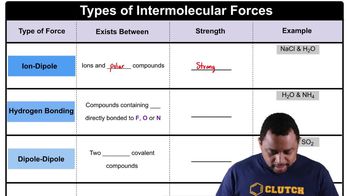
Strong dipole–dipole attractions between H bonded to N, O, or F and lone pairs on N, O, or F of another molecule.
Water forms hydrogen bonds requiring more energy to break, while H2S lacks hydrogen bonding.
Ionic bonds > Hydrogen bonds > Dipole–dipole attractions > Dispersion forces.
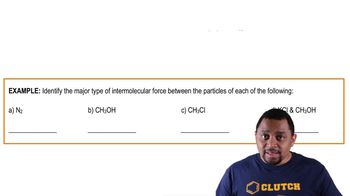
Dispersion forces, caused by temporary induced dipoles, are the only forces in nonpolar molecules.
Polar and ionic substances dissolve in polar solvents; nonpolar substances dissolve in nonpolar solvents.
Lone pairs can create asymmetry in shape, preventing dipole cancellation and making molecules polar.
Electronegativity differences cause unequal sharing of electrons, creating bond dipoles.
Draw Lewis structure, determine shape, check bond polarities, and see if dipoles cancel or add up.
Strong ionic bonds between oppositely charged ions in a crystal lattice.
Hydrogen in CH4 is bonded to carbon, not N, O, or F, so no hydrogen bonding occurs.