 Indietro
GOB Chemistry: Gases and Gas Laws
 02:13

Termini in questo insieme (20)
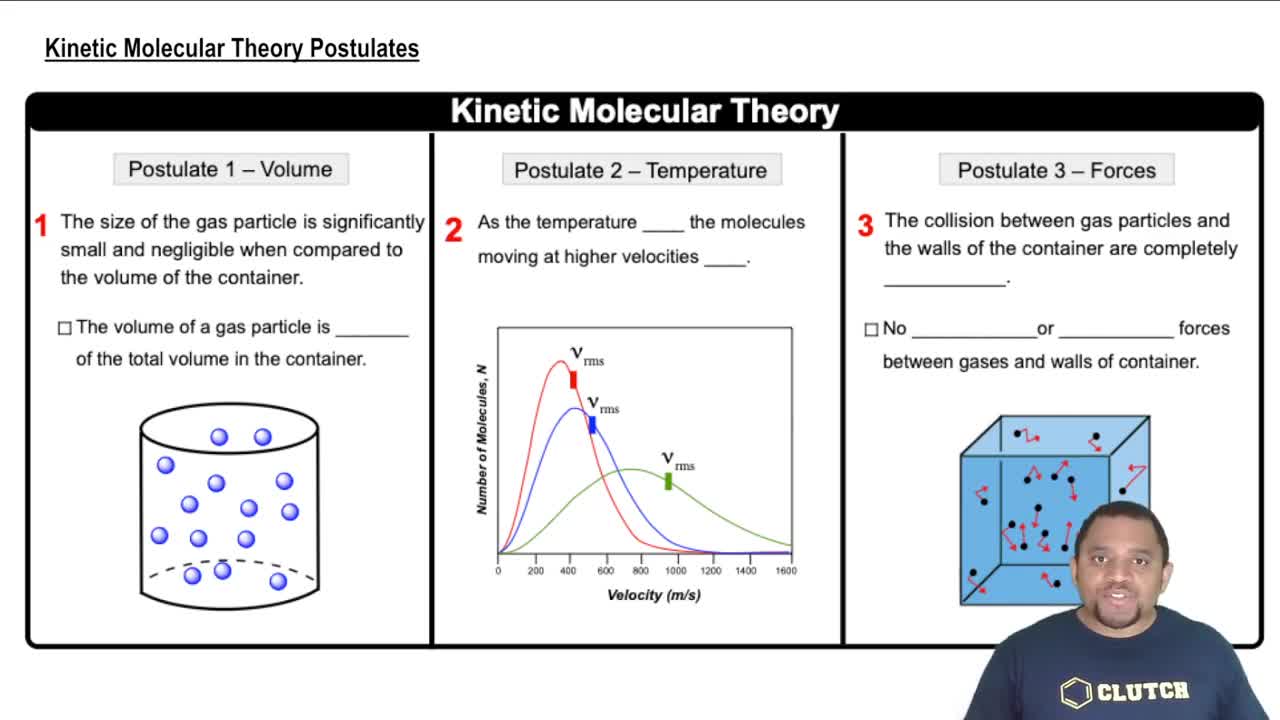
A gas consists of small particles that move randomly with high velocities, have very small attractive forces, occupy a larger volume than the molecules alone, and are in constant straight-line motion.
Pressure (P), Volume (V), Temperature (T), and Amount (n).
Volume equals the volume of the container, measured in liters or milliliters, and increases with temperature at constant pressure.
Measured in Kelvin (K), it relates to the average kinetic energy of molecules; increasing temperature increases molecular collisions.
Pressure is the force of gas particle collisions on container walls, measured in mmHg, atm, Pa, kPa, or psi.
Pressure exerted by the air column from Earth's surface to the top of the atmosphere; about 1 atm at sea level and decreases with altitude.
Measures atmospheric pressure by the height of mercury in a tube; 760 mmHg equals 1 atm.
A water barometer is 13.6 times taller than a mercury barometer because water is less dense than mercury.
The pressure of a gas is inversely proportional to its volume at constant temperature and amount: \(PV=\text{constant}\).
During inhalation, lung volume increases and pressure decreases, causing air to flow in; during exhalation, volume decreases and pressure increases, pushing air out.
Use \(P_1V_1=P_2V_2\) to find unknown volume or pressure when temperature and moles are constant.
1 atm = 760 mmHg = 760 Torr; use conversion factors to switch between units.
Atmospheric pressure decreases as altitude increases, e.g., 0.70 atm at mountain peaks.
Common units include millimeters of mercury (mmHg), atmospheres (atm), pascals (Pa), kilopascals (kPa), and pounds per square inch (psi).
Gas particles move rapidly in straight lines and exert pressure by colliding with container walls.
Increasing temperature increases molecular collisions; decreasing temperature reduces collisions.
When a piston compresses gas volume, pressure increases; when volume expands, pressure decreases (Boyle's Law).
For 8.0 L gas at 550 mmHg compressed to 2200 mmHg, new volume is 2.0 L using Boyle's Law.
Oxygen gas volume changes from 12.0 L to 36.0 L at 600 mmHg; new pressure is 200 mmHg.
Increasing pressure decreases volume; decreasing pressure increases volume, assuming constant temperature and moles.