Indietro

GOB Chemistry: TCA Cycle & Electron Transport Chain 17

I pulsanti di controllo sono stati cambiati in modalità "navigazione".
1/19
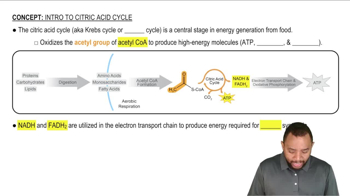
  • Where does the TCA cycle take place in the cell?

    The TCA cycle occurs in the mitochondrial matrix of eukaryotic cells.
  • What is the main purpose of the TCA cycle?

    • To oxidize acetyl-CoA to CO2 and produce reduced coenzymes (NADH, FADH2) for energy extraction.

    • Release the energy stored in the two

      carbon (acetyl) group via an aerobic

      pathway

  • How many turns of the TCA cycle occur per glucose molecule?

    Two turns, because one glucose produces two molecules of acetyl-CoA.
  • Which TCA cycle steps produce reduced coenzymes and ATP?

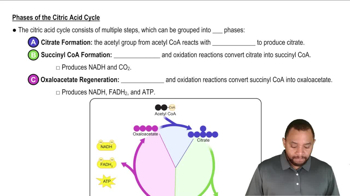
    Steps 3 and 4 produce NADH and CO2; step 5 produces GTP (ATP equivalent); step 6 produces FADH2; step 8 produces NADH.
  • Name the enzyme that catalyzes the first step of the TCA cycle.

    Citrate synthase catalyzes the condensation of acetyl-CoA and oxaloacetate to form citrate.
  • How is pyruvate dehydrogenase regulated?

    Inhibited by high energy molecules (ATP, NADH, Acetyl-CoA) and activated by low energy molecules (NAD+, AMP, CoA-SH).
  • What are the three enzymes of the pyruvate dehydrogenase complex?

    1) Pyruvate dehydrogenase, 2) Dihydrolipoyl transacetylase, 3) Dihydrolipoyl dehydrogenase.
  • What is the role of NADH and FADH2 in cellular respiration?

    They are high energy molecules that donate electrons to the electron transport chain for ATP production.
  • Where does the electron transport chain occur?

    In the inner mitochondrial membrane.
  • What is the main function of the electron transport chain?

    To couple the oxidation of NADH and FADH2 with the phosphorylation of ADP to produce ATP.
  • Which complexes in the electron transport chain pump protons?

    Complexes I, III, and IV are proton pumps that create a proton gradient.
  • What is the final electron acceptor in the electron transport chain?

    Molecular oxygen (O2), which combines with electrons and protons to form water.
  • How does ATP synthase produce ATP?

    Protons flow back into the mitochondrial matrix through ATP synthase, driving the phosphorylation of ADP to ATP.
  • Why is the maintenance of the membrane potential important?

    It stores energy as a proton gradient, which is essential for ATP synthesis by ATP synthase.
  • What is the net ATP yield from one glucose molecule after complete oxidation?

    Approximately 38 ATP molecules are produced per glucose molecule.
  • What happens to the remaining 60% of energy from glucose oxidation?

    It is released as heat energy to help maintain body temperature.
  • Classify citrate synthase enzyme type.

    Citrate synthase is a transferase enzyme, transferring functional groups.
  • What substrates enter Complex I and Complex II of the electron transport chain?

    Complex I: NADH; Complex II: FADH2 (from succinate).
  • What are the products of Complex IV in the electron transport chain?

    Water (H2O) is produced by the reduction of oxygen.