 Indietro
Lec 15.1 GOB Chemistry: Metabolism & ATP
 1:23

Termini in questo insieme (20)
Solar energy is the ultimate source of energy on Earth, driving photosynthesis in plants and supporting life.
Plants convert solar energy into chemical energy (glucose), which animals consume. Animals release CO2 used by plants, creating an energy cycle.
Energy must be released gradually, stored accessibly, released precisely when needed, maintain body temperature, and drive non-favorable chemical reactions.
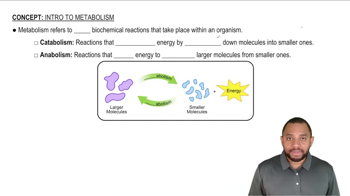
Metabolism is the sum of all chemical reactions in an organism, including anabolism (building molecules) and catabolism (breaking down molecules for energy).
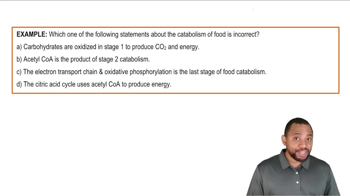
1) Digestion of macromolecules, 2) Breakdown into oxidized forms (acetyl-CoA), 3) Oxidation of acetyl-CoA to CO2 and reduced coenzymes, 4) Oxidative phosphorylation producing ATP and H2O.
Exergonic reactions release energy (ΔG negative), occur spontaneously. Endergonic reactions require energy input (ΔG positive), are nonspontaneous.
Coupling allows energy released from exergonic reactions to drive endergonic reactions, making overall processes energetically favorable.
1) Highly exergonic and irreversible, 2) Have a committed step, 3) Are regulated, 4) Occur in specific cellular locations.
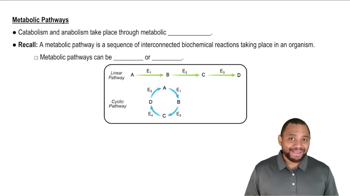
Linear (sequential reactions), Cyclic (regenerates initial substrate), Spiral (polymer breakdown one monomer at a time).
High energy molecules include ATP, Acetyl-CoA, NADH, and FADH2.
NAD+ and FAD are oxidized forms; NADH and FADH2 are their reduced, high-energy forms involved in redox reactions.
Vitamins like niacin (B3) and riboflavin (B2) are precursors for coenzymes NAD+/NADH and FAD/FADH2, essential for redox reactions in metabolism.
ATP stores a medium amount of energy, is stable at physiological pH, requires enzymes for hydrolysis, and its bonds are easily cleaved to release energy.
Coupled reactions link an exergonic reaction to an endergonic one, allowing energy transfer to drive non-spontaneous processes essential for life.
ATP hydrolysis to ADP releases energy with ΔG = -7.3 kcal/mol, making it an exergonic reaction.
The committed step is a highly regulated, often irreversible reaction that commits substrates to a specific metabolic pathway.
Glycolysis occurs in the cytosol, TCA cycle in the mitochondrial matrix, and electron transport chain in the inner mitochondrial membrane.
Acetyl-CoA is oxidized to produce CO2 and reduced coenzymes (NADH, FADH2).
CoA carries acetyl groups into the TCA cycle; it is derived from vitamin B5 (pantothenic acid).
ATP hydrolysis relieves electrostatic repulsion between phosphate groups and produces products stabilized by resonance, releasing energy.