 Indietro
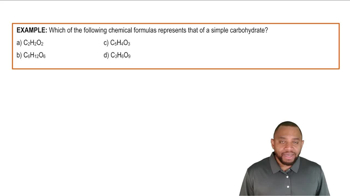
Lec 15.2 GOB Chemistry: Carbohydrates
 0:57

Termini in questo insieme (20)
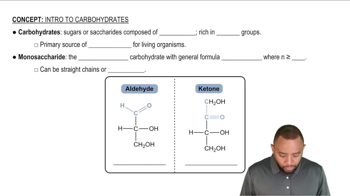
A monosaccharide is a carbohydrate that cannot be hydrolyzed into smaller sugars and contains 3 to 7 carbons.
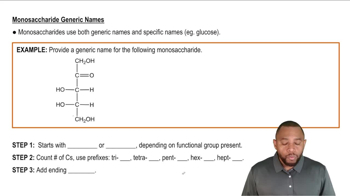
An aldose contains an aldehyde group; a ketose contains a ketone group.
D & L isomers (enantiomers), diastereomers, and anomers.
D isomers have the -OH on the last chiral carbon pointing right; L isomers have it pointing left in Fischer projection.
Anomers are cyclic sugars differing in the position of the -OH group on the anomeric (hemiacetal) carbon, alpha or beta.
A carbohydrate with a free anomeric carbon (hemiacetal) that can be oxidized; it can reduce other chemicals.
Measures glucose concentration in blood or urine by oxidizing glucose and producing a color change.
A bond between the anomeric carbon of a monosaccharide and an -OR group, forming acetals or glycosides.
By the configuration of the anomeric carbon involved in the glycosidic bond.
Maltose (glucose-glucose), lactose (galactose-glucose), and sucrose (glucose-fructose).
Maltose: α-1,4; Lactose: β-1,4; Sucrose: α-1,β-2 linkage.
Sucralose resembles sucrose structurally.
Aspartame is made from amino acids.
Sugar feeds bacteria like Streptococcus mutans, which produce acid that lowers pH and dissolves tooth enamel.
Energy source, metabolic intermediates, anticoagulants, joint lubricants, cell surface receptors, and blood type determinants.
Type O lacks A and B carbohydrate antigens on red blood cells, so it is not attacked by recipient antibodies.
Glycogen and starch have α-1,4 and α-1,6 linkages; cellulose has β-1,4 linkages. Cellulose is linear and indigestible by humans.
Humans can digest glycogen and starch but not cellulose.
Heparin contains mainly β-1,4 glycosidic bonds.
They are covalently bound to proteins and lipids on the outside of red blood cell membranes.