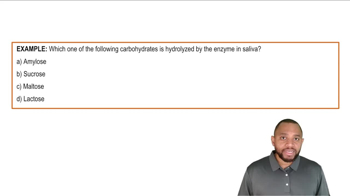
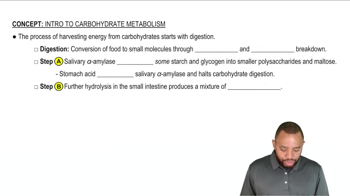
Where are carbohydrates digested in Stage 1 of catabolism?
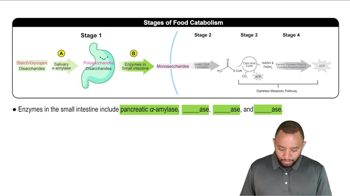
Carbohydrates are digested in the mouth (salivary α-amylase), stomach, and small intestine (pancreatic α-amylase), with absorption through the small intestines.
Define Glycolysis.
Glycolysis is the metabolic pathway that converts glucose into two molecules of pyruvate while producing energy.
Define Gluconeogenesis.
Gluconeogenesis is the synthesis of glucose from amino acids, pyruvate, and non-carbohydrate sources.
Define Glycogenesis.
Glycogenesis is the synthesis of glycogen from glucose.
Define Glycogenolysis.
Glycogenolysis is the breakdown of glycogen to glucose.
Define the Pentose Phosphate Pathway.
The Pentose Phosphate Pathway converts glucose to five-carbon sugar phosphates used for nucleic acid synthesis and lipid biosynthesis.
What is the purpose of glycolysis?
The purpose of glycolysis is to convert glucose to two molecules of pyruvate while producing energy in the form of ATP and NADH.
Which steps in glycolysis use ATP?
Steps 1 (hexokinase) and 3 (phosphofructokinase) use ATP to phosphorylate glucose and fructose-6-phosphate, respectively.
Which steps in glycolysis produce ATP?
Steps 7 (phosphoglycerate kinase) and 10 (pyruvate kinase) produce ATP via substrate-level phosphorylation.
Which step produces reduced coenzymes in glycolysis?
Step 6 (glyceraldehyde 3-phosphate dehydrogenase) produces NADH, a reduced coenzyme.
Why is the phosphorylation of glucose important in glycolysis?
Phosphorylation traps glucose inside the cell and activates it by making it a high-energy molecule, enabling further metabolism.
Why is the conversion of fructose-6-phosphate to fructose-1,6-bisphosphate highly regulated?
It is the committed step of glycolysis, highly exergonic, irreversible, and regulated allosterically by ATP, citrate (inhibitors), and ADP/AMP (activators).
What happens to pyruvate during anaerobic respiration?
Pyruvate is converted to lactate to regenerate NAD+ for glycolysis to continue under low oxygen conditions.
What happens to pyruvate during aerobic respiration?
Pyruvate is converted to acetyl-CoA by pyruvate dehydrogenase and enters the citric acid cycle for complete oxidation.
Why do red blood cells metabolize glucose anaerobically?
RBCs lack mitochondria, so they convert pyruvate to lactate anaerobically to regenerate NAD+ and produce ATP via glycolysis.
 Indietro
 1:51