Ch.6 Carbohydrates Life's Sweet Molecules
Frost - General, Organic and Biological Chemistry 4th Edition
Frost4th EditionGeneral, Organic and Biological ChemistryISBN: 9780134988696Non è quello che usi tu?Cambia libro di testo
Capitolo 3, Problema 29

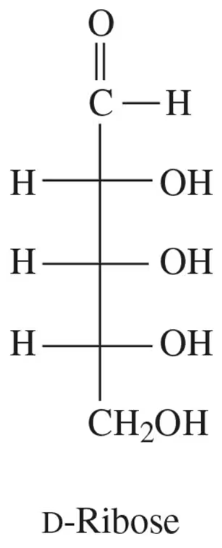
The sugar alcohol ribitol is a component of the vitamin riboflavin and the energy transfer molecule FAD. Ribitol is formed when the monosaccharide ribose undergoes reduction at carbon 1. Draw the structure of ribitol.

Guida verificata passo dopo passo
1
Understand the problem: Ribitol is formed by the reduction of d-ribose at carbon 1. Reduction involves the addition of hydrogen atoms to the aldehyde group at carbon 1, converting it into a primary alcohol group.
Examine the structure of d-ribose: d-Ribose is a monosaccharide with five carbon atoms. It contains an aldehyde group (-CHO) at carbon 1 and hydroxyl groups (-OH) attached to carbons 2, 3, 4, and 5.
Apply the reduction process: During reduction, the aldehyde group (-CHO) at carbon 1 is converted into a primary alcohol group (-CH₂OH). This involves the addition of hydrogen atoms to the carbon and oxygen in the aldehyde group.
Draw the structure of ribitol: After reduction, ribitol will have a chain of five carbon atoms, each bonded to a hydroxyl group (-OH). The carbon 1 will now have a primary alcohol group (-CH₂OH) instead of an aldehyde group.
Verify the structure: Ensure that the resulting structure has five carbons, each with a hydroxyl group (-OH), and that carbon 1 has been correctly reduced to a primary alcohol group (-CH₂OH). This structure represents ribitol.

Risposta video verificata per un problema simile:

Questa soluzione video è stata consigliata dai nostri tutor come utile per risolvere questo problema.
Durata del video:
2m

Concetti chiave

Ecco i concetti essenziali che devi comprendere per rispondere correttamente alla domanda.

Ribitol Structure

Ribitol is a sugar alcohol derived from ribose, specifically formed by the reduction of the aldehyde group at carbon 1 of ribose to a hydroxyl group. This structural change transforms ribose, a five-carbon sugar, into ribitol, which is characterized by its alcohol functional group. Understanding the structural formula of ribitol is essential for visualizing its role in biological molecules.
Video consigliato:
Percorso guidato
1:01
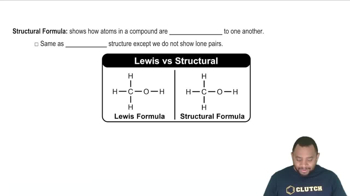
Structural Formula Concept 2

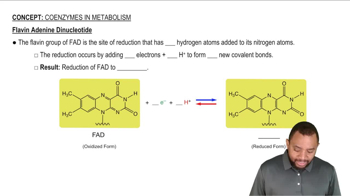
Riboflavin and FAD

Riboflavin, also known as vitamin B2, is a vital nutrient that plays a crucial role in energy metabolism. It is a precursor to flavin adenine dinucleotide (FAD), a coenzyme involved in various biochemical reactions, including the Krebs cycle. Ribitol is a component of riboflavin, highlighting its importance in cellular energy transfer processes.
Video consigliato:
Percorso guidato
1:05
Flavin Adenine Dinucleotide Concept 3

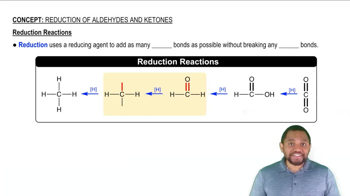
Reduction Reaction

A reduction reaction involves the gain of electrons or hydrogen by a molecule, resulting in a decrease in oxidation state. In the case of ribitol formation, ribose undergoes reduction at its carbon 1, converting the aldehyde group into a hydroxyl group. This process is fundamental in organic chemistry and biochemistry, as it alters the properties and reactivity of the molecule.
Video consigliato:
Percorso guidato
2:38
Reduction Reactions Concept 1