Ch.14 Carboxylic Acids, Esters, Amines, and Amides
Timberlake - Chemistry: An Introduction to General, Organic, and Biological Chemistry 13th Edition
Timberlake13th EditionChemistry: An Introduction to General, Organic, and Biological ChemistryISBN: 9780134421353Non è quello che usi tu?Cambia libro di testo
Capitolo 14, Problema 9a

Write the balanced chemical equation for the dissociation of each of the following carboxylic acids in water:
a. pentanoic acid

Guida verificata passo dopo passo
1
Identify the chemical formula for pentanoic acid. Pentanoic acid is a carboxylic acid with the molecular formula C5H10O2. Its structure includes a carboxyl group (-COOH) attached to a pentane chain.
Understand the dissociation process of carboxylic acids in water. Carboxylic acids dissociate by donating a proton (H⁺) from the carboxyl group to water, forming a hydronium ion (H₃O⁺) and the conjugate base of the acid.
Write the general dissociation equation for a carboxylic acid (R-COOH) in water: R-COOH + H₂O → R-COO⁻ + H₃O⁺. Here, R represents the alkyl group attached to the carboxyl group.
Substitute the specific structure of pentanoic acid into the general equation. The alkyl group (R) in pentanoic acid is C4H9, so the dissociation equation becomes: C4H9-COOH + H₂O → C4H9-COO⁻ + H₃O⁺.
Verify that the equation is balanced. Ensure that the number of atoms and charges are equal on both sides of the equation. In this case, the equation is already balanced as written.

Risposta video verificata per un problema simile:

Questa soluzione video è stata consigliata dai nostri tutor come utile per risolvere questo problema.
Durata del video:
2m

Concetti chiave

Ecco i concetti essenziali che devi comprendere per rispondere correttamente alla domanda.

Carboxylic Acids

Carboxylic acids are organic compounds characterized by the presence of one or more carboxyl groups (-COOH). They are known for their acidic properties due to the ability of the carboxyl group to donate a proton (H+) in solution. This makes them important in various chemical reactions, including dissociation in water, where they release protons and form carboxylate ions.
Video consigliato:
Percorso guidato
1:09
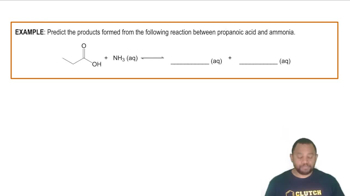
Carboxylic Acid Reactions Example 1

Dissociation in Water

Dissociation in water refers to the process by which a compound separates into its constituent ions when dissolved in water. For carboxylic acids, this involves the release of a proton (H+) from the carboxyl group, resulting in the formation of a negatively charged carboxylate ion. Understanding this process is crucial for writing balanced chemical equations that accurately represent the behavior of acids in aqueous solutions.
Video consigliato:
Percorso guidato
02:06
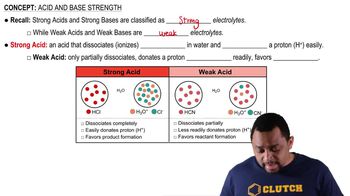
Acid and Base Strength Concept 1

Balanced Chemical Equation

A balanced chemical equation represents a chemical reaction with equal numbers of each type of atom on both sides of the equation. Balancing is essential to comply with the law of conservation of mass, which states that matter cannot be created or destroyed in a chemical reaction. In the context of carboxylic acids, writing a balanced equation for their dissociation involves ensuring that the number of atoms of each element is the same before and after the reaction.
Video consigliato:
Percorso guidato
01:32
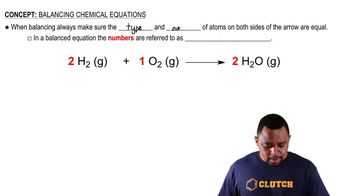
Balancing Chemical Equations (Simplified) Concept 1