Ch.16 Amino Acids, Proteins, and Enzymes
Timberlake - Chemistry: An Introduction to General, Organic, and Biological Chemistry 13th Edition
Timberlake13th EditionChemistry: An Introduction to General, Organic, and Biological ChemistryISBN: 9780134421353Non è quello che usi tu?Cambia libro di testo
Capitolo 16, Problema 34a

What is the name of the class of enzymes that would catalyze each of the following reactions?
a. addition of water to a double bond

Guida verificata passo dopo passo
1
Understand the reaction: The addition of water to a double bond is a type of chemical reaction where a molecule of water (H₂O) is added across the double bond of an organic compound, typically resulting in the formation of an alcohol.
Recall the enzyme classification system: Enzymes are categorized into six major classes based on the type of reaction they catalyze. These classes include oxidoreductases, transferases, hydrolases, lyases, isomerases, and ligases.
Identify the relevant enzyme class: The addition of water to a double bond is typically catalyzed by enzymes known as 'hydrolases' or 'lyases,' depending on the specific mechanism. Hydrolases catalyze reactions involving water, while lyases often add or remove groups to form double bonds.
Focus on hydration reactions: Specifically, enzymes called 'hydratases' (a subclass of lyases) are responsible for catalyzing the addition of water to a double bond. These enzymes facilitate the hydration process without breaking the molecule into smaller fragments.
Conclude the enzyme class: Based on the reaction described, the class of enzymes that catalyze the addition of water to a double bond is 'lyases,' and more specifically, 'hydratases.'

Risposta video verificata per un problema simile:

Questa soluzione video è stata consigliata dai nostri tutor come utile per risolvere questo problema.
Durata del video:
4m

Concetti chiave

Ecco i concetti essenziali che devi comprendere per rispondere correttamente alla domanda.

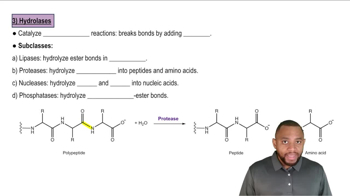
Hydrolases

Hydrolases are a class of enzymes that catalyze the hydrolysis of various bonds, including the addition of water to a double bond. This reaction typically involves breaking a chemical bond by the addition of water, resulting in the formation of two products. In the context of the question, hydrolases facilitate the conversion of alkenes into alcohols through this mechanism.
Video consigliato:
Percorso guidato
2:18
Hydrolases Concept 6

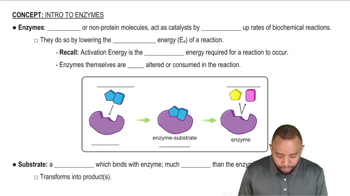
Enzyme Catalysis

Enzyme catalysis refers to the process by which enzymes accelerate chemical reactions. Enzymes lower the activation energy required for a reaction to occur, allowing it to proceed more quickly and efficiently. This is crucial in biological systems, where many reactions would occur too slowly without the action of enzymes.
Video consigliato:
Percorso guidato
2:14
Intro to Enzymes Concept 1

Substrate Specificity

Substrate specificity is the ability of an enzyme to selectively catalyze a reaction for a particular substrate or group of substrates. This specificity is determined by the enzyme's active site, which has a unique shape and chemical environment that fits only certain molecules. Understanding substrate specificity is essential for predicting the reactions that a given enzyme can catalyze.
Video consigliato:
Percorso guidato
01:37
Specific Gravity