Ch.3 Matter and Energy
Timberlake - Chemistry: An Introduction to General, Organic, and Biological Chemistry 14th Edition
Timberlake14th EditionChemistry: An Introduction to General, Organic, and Biological ChemistryISBN: 9781292472249Non è quello che usi tu?Cambia libro di testo
Capitolo 3, Problema 100

A 45-g piece of ice at 0.0 °C is added to a sample of water at 8.0 °C. All of the ice melts and the temperature of the water decreases to 0.0 °C. How many grams of water were in the sample?

Guida verificata passo dopo passo
1
Step 1: Identify the energy required to melt the ice. Use the formula \( q = m \cdot \Delta H_{fus} \), where \( m \) is the mass of the ice (45 g) and \( \Delta H_{fus} \) is the heat of fusion for water (334 J/g). This will give the energy needed to convert the ice at 0.0 °C to liquid water at 0.0 °C.
Step 2: Determine the energy lost by the water sample as it cools from 8.0 °C to 0.0 °C. Use the formula \( q = m \cdot c \cdot \Delta T \), where \( m \) is the mass of the water sample (unknown), \( c \) is the specific heat capacity of water (4.18 J/g·°C), and \( \Delta T \) is the temperature change (8.0 °C - 0.0 °C).
Step 3: Set up an energy balance equation. The energy lost by the water sample as it cools to 0.0 °C must equal the energy required to melt the ice. This gives \( m_{water} \cdot c \cdot \Delta T = m_{ice} \cdot \Delta H_{fus} \).
Step 4: Rearrange the energy balance equation to solve for \( m_{water} \), the mass of the water sample. Substitute the known values for \( m_{ice} \), \( \Delta H_{fus} \), \( c \), and \( \Delta T \).
Step 5: Perform the calculation using the rearranged formula to find \( m_{water} \). Ensure units are consistent throughout the calculation (e.g., grams and joules).

Risposta video verificata per un problema simile:

Questa soluzione video è stata consigliata dai nostri tutor come utile per risolvere questo problema.
Durata del video:
3m

Concetti chiave

Ecco i concetti essenziali che devi comprendere per rispondere correttamente alla domanda.

Heat Transfer

Heat transfer is the process of thermal energy moving from one object or substance to another due to a temperature difference. In this scenario, heat flows from the warmer water at 8.0 °C to the colder ice at 0.0 °C, causing the ice to melt and the water temperature to decrease. Understanding this concept is crucial for analyzing how energy is exchanged in the system.
Video consigliato:

Latent Heat of Fusion

Latent heat of fusion is the amount of heat required to convert a unit mass of a solid into a liquid at its melting point without changing its temperature. For ice, this value is approximately 334 J/g. This concept is essential for calculating the energy needed to melt the ice in the problem, which directly influences the final temperature of the water.
Video consigliato:

Specific Heat Capacity

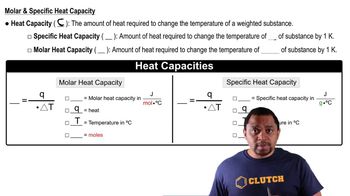
Specific heat capacity is the amount of heat required to raise the temperature of a unit mass of a substance by one degree Celsius. Water has a specific heat capacity of about 4.18 J/g°C. This concept is important for determining how much energy the water loses as its temperature decreases from 8.0 °C to 0.0 °C, which helps in finding the mass of the water sample.
Video consigliato: