 Indietro
Human Biology: Digestive and Respiratory Systems & Genetics
 06:13

Termini in questo insieme (37)
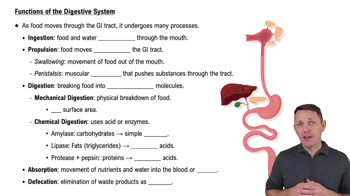
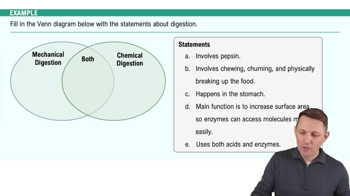
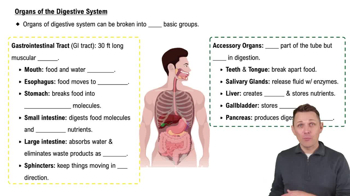
Mouth: Begins mechanical digestion (chewing) and chemical digestion (saliva contains enzymes).
Esophagus: Transports food from the mouth to the stomach via peristalsis (muscular contractions).
Stomach: Mixes food with gastric juices, starts protein digestion, and turns food into chyme.
Small Intestine: Main site for digestion and absorption of nutrients; aided by enzymes from the pancreas and bile from the liver.
Liver: Produces bile to help digest fats and processes nutrients absorbed from the small intestine.
Gallbladder: Stores and releases bile into the small intestine.
Pancreas: Produces digestive enzymes and bicarbonate released into the small intestine.
Large Intestine (Colon): Absorbs water and electrolytes, forming and storing feces.
Rectum: Stores feces before elimination.
Anus: Controls the release of feces from the body.
Air enters through the nose or mouth, passes through the pharynx and larynx, then down the trachea into bronchi and bronchioles ending in alveoli.
Oxygen diffuses from alveoli into the blood; carbon dioxide diffuses from blood into alveoli to be exhaled.
The diaphragm and intercostal muscles control inhalation and exhalation by moving air in and out of the lungs.
Homozygous: An individual has two identical alleles for a gene (e.g., AA or aa).
Heterozygous: An individual has two different alleles for a gene (e.g., Aa).
Genotype: The genetic makeup of an organism; the specific alleles present (e.g., AA, Aa, or aa).
Phenotype: Observable traits of an organism resulting from genotype and environmental influences (e.g., eye color, height).
Actions such as flexion, extension, rotation, abduction, and adduction are possible in which of the following joints?
Synovial joints
Consistent levels of calcium and phosphate must be maintained in the blood. Low levels of these ions in the blood would therefore, stimulate the activity of ________.
osteoclasts
The production of new blood cells requires the activity of ________.
stem cells in the red marrow
Which one of the following muscles separates the thoracic cavity from the abdominal cavity?
diaphragm
What best describes the function of a tendon?
to connect a muscle to a bone
As part of your fitness training, you do biceps curls lifting two 10-lb weights. The muscle contractions enabling these movements are
isotonic contractions
The contractile unit of a muscle is ________.
a sarcomere
In which of the following ways is cardiac muscle similar to skeletal muscle?
Cardiac muscle and skeletal muscle are both striated
Which of the following events does NOT occur during muscle contraction?
Myosin filaments shorten
Fast-twitch muscle fibers ________.
have few mitochondria
What is the term for the alternative versions of the same gene (e.g., brown and blue eye color)?
allele
An individual who possesses two different alleles for a particular gene is referred to as ________.
heterozygous
If both alleles of a particular gene are identical, the person is said to be
homozygous
The genes for sex-linked traits are
found on the X or Y chromosomes
The inheritance of phenotypic traits that depend on many genes is called ________.
polygenic inheritance
The digestion of which macronutrients occurs primarily in the stomach?
proteins
Which enzyme digests most dietary carbohydrates?
amylase, which is found in saliva
The function of the gallbladder is to ________.
store and concentrate bile
Enzymes secreted by the pancreas travel down the pancreatic duct and empty into the
duodenum
A primary function of the large intestine (colon) is to ________.
absorb water from feces