Skip to main content
Intermediate Algebra
Il mio corso
Impara
Preparazione agli esami
AI Tutor
Guide di studio
Flashcard
Esplora
Prova l'app
Il mio corso
Impara
Preparazione agli esami
AI Tutor
Guide di studio
Flashcard
Esplora
Prova l'app
Indietro
Solving Rational Equations in Intermediate Algebra
Puoi toccare per girare la carta.
What is the first step in solving a rational equation?
Puoi toccare per girare la carta.
👆
What is the first step in solving a rational equation?
Factor each denominator.
Avanzamenti del tracciato
I pulsanti di controllo sono stati cambiati in modalità "navigazione".
1/27
Video consigliati
VideoThumbView.guidedCourse
05:21
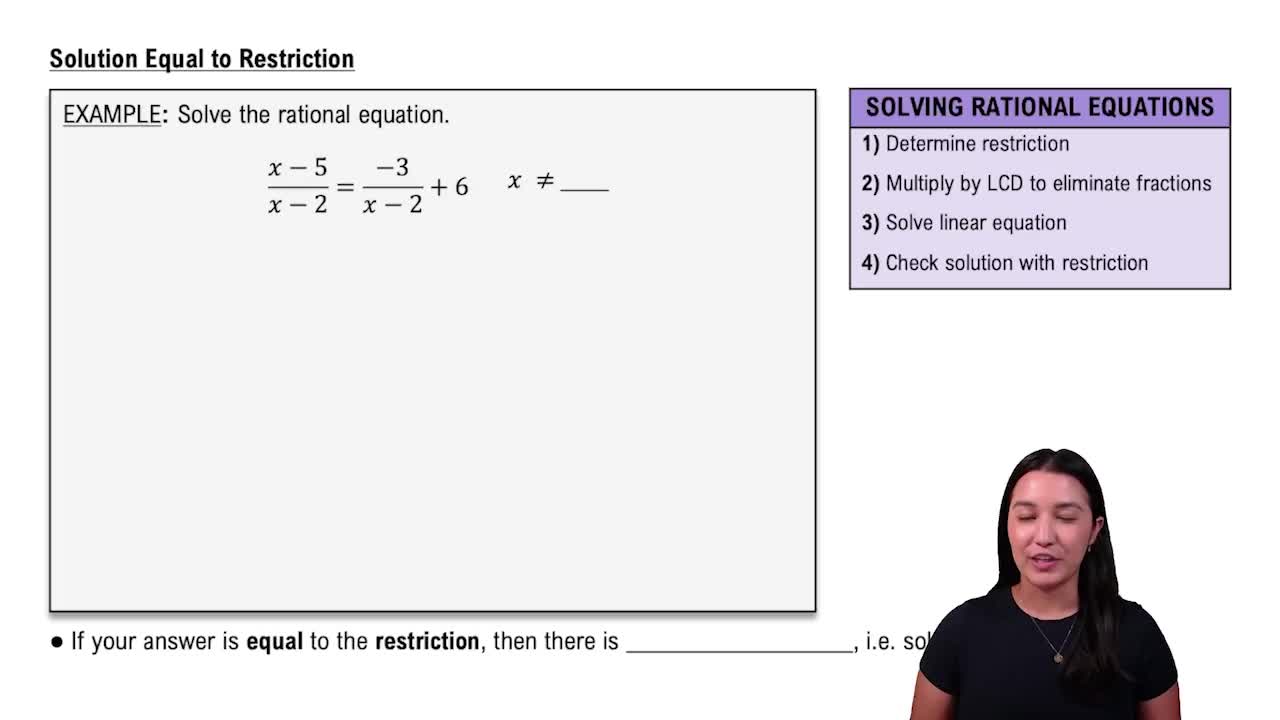
Restrictions on Rational Equations
147
views
2
rank
VideoThumbView.guidedCourse
08:59
Solving Rational Equations Example 1
158
views
2
rank
VideoThumbView.guidedCourse
05:56
Solving Rational Equations
234
views
5
rank
Termini in questo insieme (27)
Nascondere definizioni
What is the first step in solving a rational equation?
Factor each denominator.
What are non-permissible values (NPVs) in rational equations?
Values that make any denominator zero and must be excluded from solutions.
What is the purpose of multiplying both sides of a rational equation by the LCD?
To eliminate denominators and simplify the equation.
How do you check for extraneous solutions in rational equations?
Verify that solutions are not NPVs; if they are, reject them as extraneous.
In the equation \(\frac{x}{2} + 3 = 2 + \frac{3x}{4}\), what is the LCD?
4
What is the solution to \(\frac{x}{2} + 3 = 2 + \frac{3x}{4}\) after multiplying by the LCD and solving?
x = 4
For the equation \(\frac{2x + 3}{x + 5} + \frac{1}{2} = \frac{7}{2x + 10}\), what are the NPVs?
x ≠ -5
What is the LCD for \(\frac{2x + 3}{x + 5} + \frac{1}{2} = \frac{7}{2x + 10}\)?
2(x + 5)
What is the solution to \(\frac{2x + 3}{x + 5} + \frac{1}{2} = \frac{7}{2x + 10}\) after multiplying by the LCD and simplifying?
x = -\(\frac{4}{5}\)
How do you factor the denominator \(x^2 - 4\)?
As (x - 2)(x + 2)
What are the NPVs for the equation with denominators \(x^2 - 4\) and \(6x + 12\)?
x ≠ 2, -2
What is the LCD for denominators (x - 2)(x + 2) and 6(x + 2)?
6(x + 2)(x - 2)
What is the solution to \(\frac{2}{x^2 - 4} + \frac{10}{6x + 12} = \frac{1}{x - 2}\) after multiplying by the LCD and simplifying?
x = 5
How do you factor \(k^2 - 4\)?
As (k + 2)(k - 2)
What are the NPVs for the equation with denominator \(k^2 - 4\)?
k ≠ -2, 2
What is the LCD for denominators (k + 2), (k - 2), and (k^2 - 4)?
(k + 2)(k - 2)
After multiplying by the LCD and simplifying, what quadratic equation results from \(\frac{4k - 1}{k + 2} - \frac{k + 1}{k - 2} = \frac{k^2 - 4k + 24}{k^2 - 4}\)?
2k^2 - 8k - 24 = 0
What are the possible solutions to 2(k + 2)(k - 6) = 0?
k = -2 or k = 6
Which solution must be rejected for the equation with NPVs k ≠ -2, 2?
k = -2
What is the final solution for the equation \(\frac{4k - 1}{k + 2} - \frac{k + 1}{k - 2} = \frac{k^2 - 4k + 24}{k^2 - 4}\)?
k = 6
How do you factor \(x^2 - x - 6\)?
As (x + 2)(x - 3)
What are the NPVs for the equation with denominator \(x^2 - x - 6\)?
x ≠ -2, 3
What is the LCD for denominators (x + 2) and (x - 3)?
(x + 2)(x - 3)
What quadratic equation results from multiplying and simplifying \(\frac{3x}{x + 2} - \frac{5}{x - 3} = \frac{-25}{x^2 - x - 6}\)?
3x^2 - 14x - 15 = 0
What are the possible solutions to (3x - 5)(x - 3) = 0?
x = \(\frac{5}{3}\) or x = 3
Which solution must be rejected due to NPVs in the equation with denominators (x + 2)(x - 3)?
x = 3
What is the final solution to \(\frac{3x}{x + 2} - \frac{5}{x - 3} = \frac{-25}{x^2 - x - 6}\)?
x = \(\frac{5}{3}\)
 IndietroIndietro
 05:21