 Indietro
Introduction to Chemistry: Matter and Energy
 01:34
01:34
Termini in questo insieme (27)
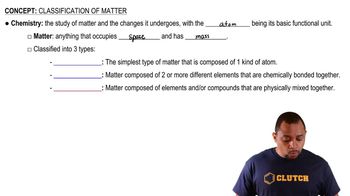
Matter is anything that occupies space and has mass.
Atoms are submicroscopic particles that are the fundamental building blocks of matter. Molecules are two or more atoms bonded together in specific geometric arrangements.
The three common states of matter are solid, liquid, and gas.
In solids, atoms or molecules are packed close in fixed locations, vibrating but not moving around each other. Solids have a fixed volume and rigid shape.
Crystalline solids have atoms arranged in a well-ordered, repeating 3D structure. Amorphous solids lack long-range order.
In liquids, atoms or molecules are close but free to move around each other. Liquids have a fixed volume but take the shape of their container.
In gases, atoms or molecules are far apart and free to move. Gases are compressible and take the shape and volume of their container.
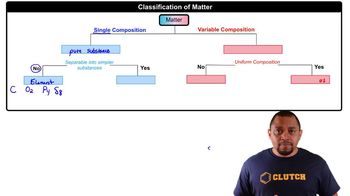
Pure substances contain only one kind of atom or molecule. Mixtures contain two or more kinds combined in variable proportions.
An element is a pure substance that cannot be broken down into simpler substances. Its smallest particle is an atom.
A compound is a pure substance composed of two or more elements chemically united in fixed, definite proportions.
Compounds are chemically bonded substances with fixed proportions, while mixtures are physical combinations of substances in variable proportions without chemical bonding.
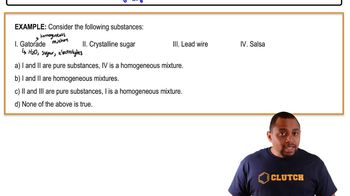
Homogeneous mixtures have uniform composition throughout. Heterogeneous mixtures have variable composition and distinct parts.
Physical properties can be observed without changing composition. Chemical properties are observed only when composition changes.
A physical change alters the appearance of matter but not its composition, such as melting or boiling.
A chemical change changes the composition of matter, producing new substances, such as rusting or burning.
The law of conservation of mass states matter is neither created nor destroyed in chemical reactions; total mass of reactants equals total mass of products.
Energy is the capacity to do work and drives the behavior of matter.
Energy is neither created nor destroyed; it can only be transformed or transferred, and the total energy remains constant.
Kinetic energy is energy of motion; potential energy is energy due to position or composition.
Exothermic reactions release energy. Endothermic reactions absorb energy.
Temperature measures the thermal energy from the random motion of atoms and molecules; higher temperature means greater motion.
Heat is the transfer of thermal energy due to temperature difference; temperature measures thermal energy within matter.
The three scales are Fahrenheit (ºF), Celsius (ºC), and Kelvin (K).
Absolute zero (0 K) is the lowest possible temperature where molecular motion virtually stops.
Specific heat capacity is the amount of heat required to raise the temperature of 1 gram of a substance by 1 ºC.
Water's high specific heat means it absorbs a lot of heat with little temperature change, helping regulate climate.
The heat absorbed or released is \(q = m C \Delta T\), where q is heat, m is mass, C is specific heat, and \(\Delta T\) is temperature change.