 Indietro
Introduction to Chemistry: Measurement and Problem Solving
 02:50
02:50
Termini in questo insieme (28)
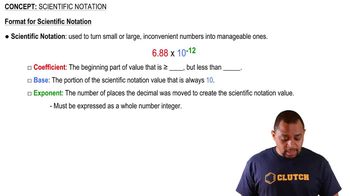
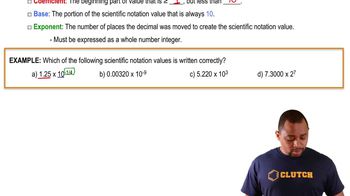
A decimal part between 1 and 10, and an exponential part which is 10 raised to an exponent.
It means 1 multiplied by 10 \(n\) times.
It means 1 divided by 10 \(n\) times.
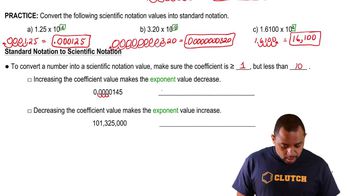
Move the decimal point to get a number between 1 and 10, then multiply by 10 raised to the power that compensates for moving the decimal point.
If the decimal point moves left, the exponent is positive; if it moves right, the exponent is negative.
By the last reported digit, which is estimated and reflects the precision of the measurement.
More digits indicate greater precision; fewer digits indicate less precision.
Mentally divide the space between markings into equal parts and estimate the last digit accordingly.
All nonzero digits, interior zeros, and trailing zeros after a decimal point are significant.
Leading zeros (zeros to the left of the first nonzero digit) are not significant.
Numbers with unlimited significant figures, such as exact counts, integral numbers in equations, and defined conversion factors.
Round only the final answer; round down if the dropped digit is 4 or less, round up if 5 or more.
The result has the same number of significant figures as the factor with the fewest significant figures.
The result has the same number of decimal places as the quantity with the fewest decimal places.
Perform operations in parentheses first, determine significant figures without rounding intermediate answers, then complete remaining steps.
A metric-based system of measurement used in science with base units like meter, kilogram, and second.
The distance light travels in vacuum in \(\frac{1}{299,792,458}\\) seconds.
Using Planck's constant as a fixed value in its definition.
As the duration of 9,192,631,770 periods of radiation from a cesium-133 atom transition.
Mass is the quantity of matter; weight is the gravitational pull on that matter and depends on gravity.
Prefixes that represent powers of ten to scale units, such as kilo- (103) and milli- (10-3).
A unit formed from base units; volume is a derived unit expressed as length cubed, e.g., cubic meters.
Using units as algebraic quantities to multiply, divide, and cancel units logically to solve problems.
By dividing two equivalent quantities to create a ratio equal to 1 for unit conversion.
A visual outline showing the strategic steps and unit conversions needed to solve a problem.
Raise the conversion factor to the same power as the units being converted.
Density is the ratio of mass to volume, calculated as \(\frac{mass}{volume}\).
To convert between mass and volume of a substance using its density value.