Skip to main content
Macroeconomics
Il mio corso
Impara
Preparazione agli esami
AI Tutor
Guide di studio
Flashcard
Esplora
Prova l'app
Il mio corso
Impara
Preparazione agli esami
AI Tutor
Guide di studio
Flashcard
Esplora
Prova l'app
Indietro
Average Total Cost: Short Run and Long Run definitions
Puoi toccare per girare la carta.
Short Run
Puoi toccare per girare la carta.
👆
Short Run
A period where some production inputs remain fixed, limiting a firm's ability to fully adjust output or costs.
Avanzamenti del tracciato
I pulsanti di controllo sono stati cambiati in modalità "navigazione".
1/14
Flashcard correlate
Video consigliati
Average Total Cost: Short Run and Long Run quiz
Average Total Cost: Short Run and Long Run
15 Termini
VideoThumbView.guidedCourse
13:13
ATC in the Short Run and Long Run
4
views
Termini in questo insieme (14)
Nascondere definizioni
Short Run
A period where some production inputs remain fixed, limiting a firm's ability to fully adjust output or costs.
Long Run
A timeframe in which all production inputs become variable, allowing firms to alter factory size and reevaluate decisions.
Fixed Costs
Expenses that do not change with output in the short run, such as leases or factory investments.
Variable Costs
Expenses that change with the level of output, becoming the only type of cost in the long run.
Average Total Cost
The total cost per unit of output, combining both fixed and variable costs, depicted as a curve on cost graphs.
Short Run Average Total Cost Curve
A graphical representation showing how per-unit costs change with output when some inputs are fixed.
Long Run Average Total Cost Curve
A curve tracing the lowest possible per-unit cost for each output level when all inputs are variable.
Economies of Scale
Cost advantages achieved as output increases, often due to bulk purchasing, specialization, or large machinery.
Constant Returns to Scale
A range where increasing output does not affect per-unit costs, resulting in a flat section on the cost curve.
Diseconomies of Scale
Rising per-unit costs at high output levels, often caused by management or coordination challenges in large firms.
Specialization
Efficiency gains from assigning specific tasks to workers, leading to lower costs at certain output levels.
Minimum Efficient Scale
The smallest output level where all possible economies of scale are realized and per-unit costs stop decreasing.
Management Coordination
The process of organizing resources and personnel, which can become complex and costly as firm size increases.
Plant Size
The scale or capacity of a firm's production facility, adjustable only in the long run.
 IndietroIndietro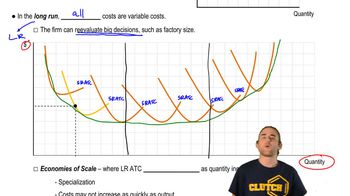
 13:13
13:13