Skip to main content
Macroeconomics
Il mio corso
Impara
Preparazione agli esami
AI Tutor
Guide di studio
Flashcard
Esplora
Prova l'app
Il mio corso
Impara
Preparazione agli esami
AI Tutor
Guide di studio
Flashcard
Esplora
Prova l'app
Indietro
Cost-Minimizing Combination of Labor and Capital quiz
Puoi toccare per girare la carta.
What is the cost-minimizing combination of inputs in production?
Puoi toccare per girare la carta.
👆
What is the cost-minimizing combination of inputs in production?
It is the combination of inputs where the isoquant curve is tangent to the isocost line, producing a given output at the lowest possible cost.
Avanzamenti del tracciato
I pulsanti di controllo sono stati cambiati in modalità "navigazione".
1/15
Flashcard correlate
Video consigliati
Cost-Minimizing Combination of Labor and Capital definitions
Cost-Minimizing Combination of Labor and Capital
15 Termini
VideoThumbView.guidedCourse
05:02
Cost Minimizing Combination of Labor and Capital
3
views
VideoThumbView.guidedCourse
01:45
Differences in Cost Minimizing Point
4
views
Termini in questo insieme (15)
Nascondere definizioni
What is the cost-minimizing combination of inputs in production?
It is the combination of inputs where the isoquant curve is tangent to the isocost line, producing a given output at the lowest possible cost.
What does an isoquant curve represent?
An isoquant curve shows all combinations of inputs that yield the same level of output.
What does an isocost line represent?
An isocost line shows all combinations of inputs that can be purchased for a given total cost.
How do you identify the cost-minimizing point on a graph with isoquant and isocost lines?
It is the point where the isoquant curve just touches (is tangent to) the isocost line.
Why is the tangent point between the isoquant and isocost lines important?
Because it represents the lowest cost combination of inputs to produce a specific output.
If you want to produce 5,000 cookies at the lowest cost, what should you look for on the graph?
You should find the point where the 5,000-cookie isoquant is tangent to an isocost line.
In the Spooky Cookies example, what is the cost-minimizing combination of inputs to produce 5,000 cookies?
The cost-minimizing combination is 4 bakers and 2 ovens.
What happens if the isocost line does not touch the isoquant for the desired output?
It means the budget is too low to produce that level of output.
How do input prices affect the position of the isocost line?
Changes in input prices shift the isocost line, altering the cost-minimizing combination of inputs.
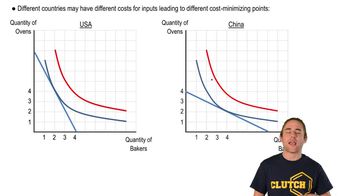
Why might different countries have different cost-minimizing input combinations?
Because input prices (like labor and capital) differ between countries, leading to different isocost lines and optimal input mixes.
In the example, why might the USA use more ovens and fewer bakers compared to China?
Because capital (ovens) is cheaper in the USA, while labor is relatively more expensive compared to China.
What does it mean if an isocost line is further from the origin?
It represents a higher budget, allowing for more inputs to be purchased.
What does it mean if an isocost line is closer to the origin?
It represents a lower budget, limiting the number of inputs that can be purchased.
How does the cost-minimizing combination relate to profit maximization?
Minimizing costs for a given output helps maximize profits, assuming output level is already chosen for profit maximization.
What is the main purpose of analyzing isoquant and isocost lines together?
To determine the most efficient (least costly) combination of inputs for producing a specific level of output.
 IndietroIndietro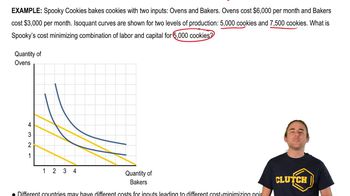
 05:02
05:02