Skip to main content
Macroeconomics
Il mio corso
Impara
Preparazione agli esami
AI Tutor
Guide di studio
Flashcard
Esplora
Prova l'app
Il mio corso
Impara
Preparazione agli esami
AI Tutor
Guide di studio
Flashcard
Esplora
Prova l'app
Indietro
Perfect Competition and Efficiency definitions
Puoi toccare per girare la carta.
Perfect Competition
Puoi toccare per girare la carta.
👆
Perfect Competition
A market structure where many firms sell identical products, ensuring no single firm can influence the market price.
Avanzamenti del tracciato
I pulsanti di controllo sono stati cambiati in modalità "navigazione".
1/15
Flashcard correlate
Video consigliati
Perfect Competition and Efficiency quiz
Perfect Competition and Efficiency
15 Termini
VideoThumbView.guidedCourse
06:46
Efficiency in Perfect Competition
4
views
Termini in questo insieme (15)
Nascondere definizioni
Perfect Competition
A market structure where many firms sell identical products, ensuring no single firm can influence the market price.
Productive Efficiency
Occurs when firms operate at the lowest possible cost, producing at the minimum point of average total cost.
Allocative Efficiency
Achieved when resources are distributed so that consumer preferences are fully reflected, with price equaling marginal cost.
Average Total Cost
Represents the total cost per unit of output, minimized at the point of productive efficiency.
Marginal Benefit
The additional satisfaction or value a consumer receives from consuming one more unit of a good.
Marginal Cost
The extra cost incurred by a producer for making one additional unit of output.
Equilibrium Price
The market price at which the quantity demanded equals the quantity supplied, reflecting both consumer and producer interests.
Demand Curve
A graphical representation showing the relationship between the price of a good and the quantity consumers are willing to buy.
Supply Curve
A graphical depiction of the relationship between the price of a good and the quantity producers are willing to sell.
Marginal Revenue
The additional income a firm receives from selling one more unit, equal to price in perfect competition.
Economic Welfare
The overall well-being and satisfaction derived from the allocation of resources in a market.
Consumer Preferences
The desires and priorities that guide buyers' choices and influence market demand.
Resource Allocation
The process of distributing inputs among different uses to maximize satisfaction and efficiency.
Profit Maximizing Point
The output level where marginal revenue equals marginal cost, ensuring optimal earnings for firms.
Market Structure
The organizational and competitive characteristics of a market, influencing efficiency outcomes.
 IndietroIndietro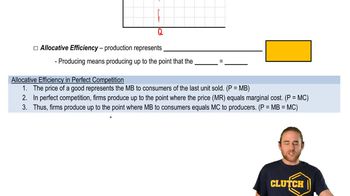
 06:46
06:46