Skip to main content
Macroeconomics
Il mio corso
Impara
Preparazione agli esami
AI Tutor
Guide di studio
Flashcard
Esplora
Prova l'app
Il mio corso
Impara
Preparazione agli esami
AI Tutor
Guide di studio
Flashcard
Esplora
Prova l'app
Indietro
The Relationship Between Average Cost and Marginal Cost definitions
Puoi toccare per girare la carta.
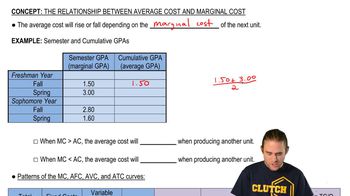
Marginal Cost
Puoi toccare per girare la carta.
👆
Marginal Cost
Change in total cost from producing one more unit, acting as the main driver for shifts in average cost.
Avanzamenti del tracciato
I pulsanti di controllo sono stati cambiati in modalità "navigazione".
1/14
Flashcard correlate
Video consigliati
The Relationship Between Average Cost and Marginal Cost quiz
The Relationship Between Average Cost and Marginal Cost
15 Termini
VideoThumbView.guidedCourse
08:56
Patterns of MC, AFC, AVC, and ATC curves
5
views
VideoThumbView.guidedCourse
06:38
Average Cost and Marginal Cost
4
views
Termini in questo insieme (14)
Nascondere definizioni
Marginal Cost
Change in total cost from producing one more unit, acting as the main driver for shifts in average cost.
Average Cost
Total cost divided by output quantity, reflecting the per-unit expense of production.
Average Fixed Cost
Portion of cost that remains constant and is spread over increasing output, always declining as output rises.
Average Variable Cost
Per-unit expense from variable inputs, typically forming a U-shape as output increases.
Average Total Cost
Sum of per-unit fixed and variable expenses, showing a U-shaped pattern as output changes.
Fixed Cost
Expense that does not change with output, such as equipment or rent, impacting only the average fixed cost.
Variable Cost
Expense that rises with increased production, influencing both average variable and total costs.
Production Efficiency
Optimal use of resources to minimize per-unit expenses, highlighted by cost curve behaviors.
Cost Management
Strategic control of expenses to optimize output and profitability, informed by cost relationships.
Diminishing Marginal Productivity
Phenomenon where adding more input eventually yields smaller increases in output, affecting cost curves.
U-Shape
Characteristic pattern of average variable and total cost curves, falling then rising with output.
Aggregate Supply
Total output available in an economy, influenced by underlying cost structures and productivity.
Quantity
Number of units produced, serving as the denominator in average cost calculations.
Total Cost
Sum of all expenses, both fixed and variable, incurred in producing a given output.
 IndietroIndietro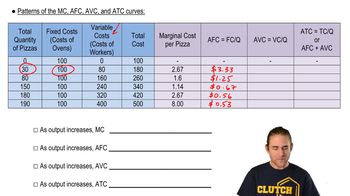
 08:56
08:56