 Indietro
Macro Midterm 3
 07:42

Termini in questo insieme (24)
Money is any asset generally accepted in exchange for goods, services, or payment of debt.
- Medium of exchange: used to buy goods and services
- Unit of account: standard measure of value
- Store of value: saves purchasing power
- Standard of deferred payment: allows future payments
Commodity money has intrinsic value (e.g., gold). Fiat money is government authorized without intrinsic value (e.g., U.S. dollar).
- Eliminates double coincidence of wants
- Makes transactions easier and more efficient
- Encourages specialization and economic development
M1 includes currency and checking deposits. M2 includes M1 plus savings deposits, small time deposits, and money market funds.
Debit cards are not money; they access money in checking accounts. Credit cards are not money; they represent short-term loans.
Banks keep a fraction of deposits as reserves and lend out the rest, creating new deposits and expanding the money supply.
Money multiplier = \(\frac{M}{B}\), where M is money supply and B is monetary base.
A bank run occurs when many depositors withdraw money simultaneously, risking bank insolvency due to fractional reserves.
FDIC insures deposits up to \$250,000 per depositor to prevent bank panics and maintain confidence.
- Lender of last resort
- Conducts monetary policy
- Influences interest rates and money supply
- Promotes economic stability
\(MV=PY\), where M is money supply, V velocity, P price level, Y real GDP. Increasing M raises P if V and Y are constant.
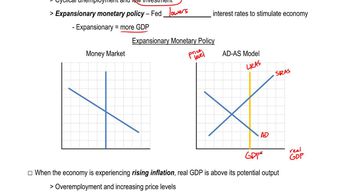
Policy to increase aggregate demand by lowering interest rates to stimulate real GDP and employment during recessions.
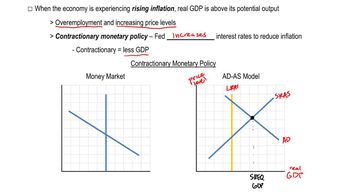
Policy to decrease aggregate demand by raising interest rates to control inflation when the economy overheats.
AD curve shifts right, increasing real GDP, price level, and employment.
AD curve shifts left, decreasing real GDP, price level, and inflationary pressure.
Connects the Fed's federal funds rate target to inflation and output gaps to guide interest rate decisions.
Interest rates cannot realistically fall below zero, limiting monetary policy stimulus via rate cuts.
The Fed buys long-term securities to increase aggregate demand when interest rate cuts are limited.
Government changes in spending and taxes to influence macroeconomic objectives like GDP and inflation.
Automatic stabilizers change spending/taxes with the cycle automatically; discretionary policy involves intentional government actions.
Increases government purchases or cuts taxes, shifting AD right, raising real GDP and price level, reducing unemployment.
Decreases government purchases or raises taxes, shifting AD left, lowering real GDP growth and inflationary pressure.
Large expansionary fiscal packages shifted AD right to offset leftward shifts in AD and SRAS due to shutdowns.