 Indietro
Macroeconomics Key Concepts and Formulas
 02:31
02:31
Termini in questo insieme (29)
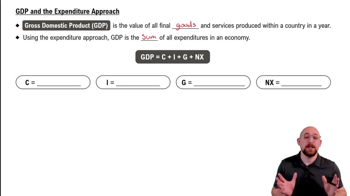
GDP is the market value of all final goods and services produced in a country during a period, typically one year.
1. Value Added (Sales - Cost of intermediate goods)
2. Total Factor Income (Sum of wages, profits, rent)
3. Total Production (Aggregate Expenditure)
Nominal GDP uses current prices; Real GDP uses base year prices to adjust for inflation.
The total number of workers and potential workers, including both employed and unemployed individuals.
Unemployment rate = (Number of unemployed / Labor force) x 100
Structural, Frictional, and Cyclical unemployment.
Inflation is an increase in the overall price level of goods and services.
CPI measures the typical consumer's cost of living based on a fixed basket of goods and services.
CPI includes imported goods and uses a fixed basket; GDP deflator excludes imports and uses a changing basket of currently produced goods.
Real GDP = (Nominal GDP / Price Deflator) x 100
Rule of 70 estimates years to double = 70 / annual growth rate (in percent).
The long-run average or target rate of unemployment when the economy is at full capacity.
Nominal interest rate is not adjusted for inflation; real interest rate is adjusted for inflation.
GNP adds income of domestic entities abroad and subtracts income of foreign entities domestically.
Labor force participation rate = (Labor force / Working age population) x 100
Individuals who have stopped looking for work in the last 4 weeks and are not counted in the labor force.
Minimum wage laws, unions, technology changes, and efficiency wages reduce available jobs.
Short-term unemployment from job search, entering/reentering workforce, or seasonal factors.
Unemployment caused by economic recessions and short-term fluctuations in the business cycle.
The level of real GDP when all firms operate at normal capacity with full employment.
Labor force growth, more capital stock, and technological advances.
GDP (Y) = Consumption (C) + Investment (I) + Government purchases (G) + Net exports (NX)
GDP (Y) = Consumption (C) + Investment (I) + Government purchases (G)
Total savings (S) = Y - C - G (Income minus consumption and government spending)
Firms like banks and mutual funds that channel funds from savers to borrowers.
Very high and accelerating inflation, often over 50% per month, eroding currency value rapidly.
A measure of income inequality ranging from 0 (equal income) to 1 (all income to one person).
Output produced per worker per hour of work.
Excludes household production, underground economy, used goods, and government transfer payments.