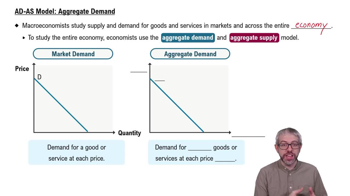
The AD-AS model represents the whole economy with Price Level on the Y-axis and Real GDP on the X-axis, showing Aggregate Demand (AD), Short-Run Aggregate Supply (SRAS), and Long-Run Aggregate Supply (LRAS).
What causes the Aggregate Demand (AD) curve to shift right?
AD shifts right when spending increases due to lower interest rates, higher government purchases, lower taxes, higher expected future income or profitability, higher foreign real GDP, lower dollar value, or increased household wealth.
What causes movement along the AD curve versus a shift of the AD curve?
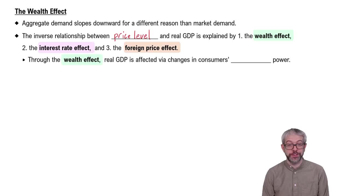
Movement along the AD curve is caused by changes in the price level. A shift of the AD curve is caused by changes in factors other than price level, like government policy or expectations.
Why is the Long-Run Aggregate Supply (LRAS) curve vertical?
LRAS is vertical because potential GDP depends on labor, capital, and technology, not the price level, reflecting the economy's full productive capacity.
What is the natural rate of unemployment?
The natural rate of unemployment includes frictional and structural unemployment present even at potential GDP, meaning unemployment is not zero at full employment.
Why does the Short-Run Aggregate Supply (SRAS) curve slope upward?
SRAS slopes upward because as prices of final goods rise, input prices like wages increase more slowly, making production more profitable and encouraging firms to produce more.
What factors shift the SRAS curve left?
SRAS shifts left when production costs increase, such as higher oil prices, higher wages, higher expected future price levels, or production disruptions.
What are the four key outcomes of shifts in AD and SRAS?
What happens when oil prices increase in the AD-AS model?
Oil price increase raises production costs, shifting SRAS left, causing GDP to fall, price level to rise, and unemployment to increase.
How does the economy adjust in the long run after a negative demand shock?
After AD shifts left causing lower GDP and higher unemployment, wages fall, reducing production costs, shifting SRAS right, and returning GDP to potential without government intervention.
What is the difference between money, income, and wealth?
Income is earnings over time, wealth is net worth (assets minus liabilities), and money is assets accepted for goods, services, or debt payment.
What components make up M1 money supply?
M1 includes currency in circulation, checking deposits, and savings deposits.
Why are bank deposits considered liabilities for banks?
Deposits are liabilities because the bank owes that money to depositors and must repay it on demand.
What are bank reserves and how are excess reserves calculated?
Bank reserves are vault cash plus deposits at the Federal Reserve. Excess reserves = Actual reserves − Required reserves.
How do banks create money through lending?
Banks lend out excess reserves from deposits, which become new checking deposits, expanding the money supply.
What are the main components of the Federal Reserve system?
The Federal Reserve consists of the Board of Governors, 12 Federal Reserve District Banks, and the Federal Open Market Committee (FOMC).
What is the difference between a bank run and a bank panic?
A bank run is many depositors withdrawing from one bank; a bank panic is runs occurring simultaneously at many banks.
What is maturity mismatch in banking?
Banks have short-term deposits but long-term loans, creating liquidity risk if many depositors demand withdrawals simultaneously.
How does FDIC deposit insurance prevent bank panics?
FDIC insurance reduces depositor fear by guaranteeing deposits up to \$250,000, lowering the incentive to withdraw funds during crises.
What are the four main tools of Federal Reserve monetary policy?
Open-market operations, discount policy, reserve requirements, and interest on reserves.
How do open-market operations affect the money supply?
Fed buys Treasury securities to increase reserves and money supply; sells securities to decrease reserves and money supply.
What happens when the Fed lowers the required reserve ratio?
Banks hold fewer reserves, can lend more, increasing loans and the money supply.
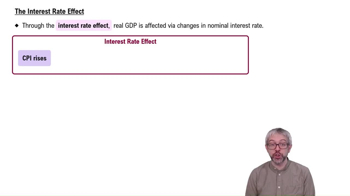
How does raising interest on reserves affect bank lending?
Higher interest on reserves encourages banks to hold more reserves, reducing lending and decreasing the money supply.
What is the quantity theory of money formula?
M × V = P × Y, where M = money supply, V = velocity, P = price level, Y = real GDP.
How is velocity of money calculated?
Velocity V = (Price Level × Real GDP) / Money Supply, or V = PY / M.
What is the inflation formula from the quantity theory of money?
Inflation = Money supply growth − Real GDP growth, assuming velocity is constant.
What causes inflation, deflation, and hyperinflation under the quantity theory?
Inflation: money supply grows faster than real GDP; deflation: money supply grows slower; hyperinflation: money supply grows much faster.
What is the government budget constraint formula?
G + TR = T + ΔB + ΔM, where G = government purchases, TR = transfers, T = taxes, ΔB = change in bonds, ΔM = change in money supply.
Who controls fiscal policy and what does it include?
Fiscal policy is controlled by the President and Congress and includes government spending, taxes, and transfer payments.
What is expansionary fiscal policy?
Used during recession when GDP is below potential; government increases spending and/or cuts taxes to shift AD right and raise GDP.
What are automatic stabilizers in fiscal policy?
Automatic changes like lower tax revenue and higher unemployment payments during recessions that increase the budget deficit without new legislation.
 Indietro
 02:56