Skip to main content
Macroeconomics
Il mio corso
Impara
Preparazione agli esami
AI Tutor
Guide di studio
Flashcard
Esplora
Prova l'app
Il mio corso
Impara
Preparazione agli esami
AI Tutor
Guide di studio
Flashcard
Esplora
Prova l'app
Indietro
The Benefits of Trade in Macroeconomics
Puoi toccare per girare la carta.
What is interdependence in trade?
Puoi toccare per girare la carta.
👆
What is interdependence in trade?
Interdependence
means countries rely on each other through trade, making everyone better off.
Avanzamenti del tracciato
I pulsanti di controllo sono stati cambiati in modalità "navigazione".
1/21
Video consigliati
VideoThumbView.guidedCourse
04:36
Opportunity Costs and Comparative Advantage
1985
views
32
rank
VideoThumbView.guidedCourse
02:03
Different PPFs and Absolute Advantage
2361
views
29
rank
Termini in questo insieme (21)
Nascondere definizioni
What is interdependence in trade?
Interdependence
means countries rely on each other through trade, making everyone better off.
What are the two goods and one resource in the example?
The two goods are
computers
and
wheat
, and the one resource is
labor
measured in hours.
How many labor hours does the U.S. have available per month?
The U.S. has
50,000 labor hours
available for production per month.
Labor hours required to produce one computer and one ton of wheat in the U.S.?
One computer requires
100 labor hours
, and one ton of wheat requires
10 labor hours
.
Maximum computers or wheat the U.S. can produce with 50,000 labor hours?
The U.S. can produce
500 computers
or
5,000 tons of wheat
or any combination on the PPF.
How many computers and tons of wheat does the U.S. produce if it splits labor equally?
With half labor on each, the U.S. produces
250 computers
and
2,500 tons of wheat
.
Labor hours available in Japan per month?
Japan has
30,000 labor hours
available for production per month.
Labor hours required to produce one computer and one ton of wheat in Japan?
One computer requires
125 labor hours
, and one ton of wheat requires
25 labor hours
.
Maximum computers or wheat Japan can produce with 30,000 labor hours?
Japan can produce
240 computers
or
1,200 tons of wheat
or any combination on the PPF.
How many computers and tons of wheat does Japan produce if it splits labor equally?
With half labor on each, Japan produces
120 computers
and
600 tons of wheat
.
What are exports and imports?
Exports
are goods produced domestically and sold abroad;
imports
are goods produced abroad and sold domestically.
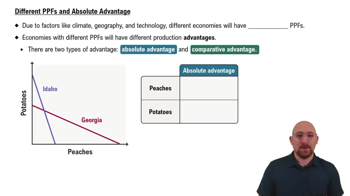
What is absolute advantage?
The ability to produce a good using
fewer inputs
than another producer.
Which country has an absolute advantage in wheat and why?
The U.S. has an absolute advantage in wheat because it requires
10 labor hours
per ton versus Japan's 25.
Which country has an absolute advantage in computers and why?
The U.S. has an absolute advantage in computers because it requires
100 labor hours
per computer versus Japan's 125.
What is opportunity cost in this trade example?
The opportunity cost of a computer is the amount of wheat that could be produced with the same labor hours.
What is comparative advantage?
The ability to produce a good at a
lower opportunity cost
than another producer.
What is the opportunity cost of a computer in the U.S.?
In the U.S., the opportunity cost of one computer is
10 tons of wheat
.
What is the opportunity cost of a computer in Japan?
In Japan, the opportunity cost of one computer is
5 tons of wheat
.
Which country has a comparative advantage in computers and why?
Japan has a comparative advantage in computers because it has a
lower opportunity cost
(5 tons wheat vs. 10 in U.S.).
Why do gains from trade arise?
Gains from trade arise from
comparative advantage
, when countries specialize in goods with lower opportunity costs.
In the Argentina and Brazil example, who has absolute and comparative advantage in coffee and wine?
Brazil has an absolute advantage in coffee; Argentina has a comparative advantage in wine due to lower opportunity cost.
 IndietroIndietro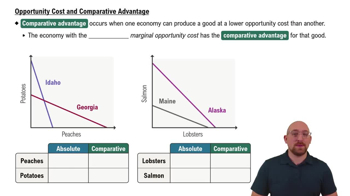
 04:36
04:36