Skip to main content
Microbiology
Il mio corso
Impara
Preparazione agli esami
AI Tutor
Guide di studio
Soluzioni per libri di testo
Flashcard
Esplora
Prova l'app
Il mio corso
Impara
Preparazione agli esami
AI Tutor
Guide di studio
Soluzioni per libri di testo
Flashcard
Esplora
Prova l'app
Indietro
Adaptive Immunity and Antigen Recognition in Microbiology
Puoi toccare per girare la carta.
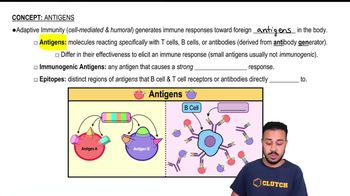
What is an antigen?
Puoi toccare per girare la carta.
👆
What is an antigen?
An
antigen
is any molecule or molecular structure that can be recognized by the immune system and elicit an immune response.
Avanzamenti del tracciato
I pulsanti di controllo sono stati cambiati in modalità "navigazione".
1/15
Video consigliati
04:11
Free Antigens vs. Presented Antigens on APCs
1652
views
15
rank
03:59
Antigens
1865
views
23
rank
Termini in questo insieme (15)
Nascondere definizioni
What is an antigen?
An
antigen
is any molecule or molecular structure that can be recognized by the immune system and elicit an immune response.
Define epitope.
An
epitope
is the specific part of an antigen that is recognized and bound by a T or B cell receptor.
What is a hapten?
A
hapten
is a small molecule that is not immunogenic by itself but can elicit an immune response when attached to a larger carrier molecule.
Explain immunogenicity.
Immunogenicity
is the ability of an antigen to provoke an immune response, influenced by factors like size, complexity, and foreignness.
What role do T cell receptors (TCRs) play in antigen recognition?
T cell receptors
recognize processed antigen fragments presented by MHC molecules on antigen-presenting cells.
How do B cell receptors (BCRs) recognize antigens?
B cell receptors
bind directly to native antigens in their natural form without processing.
How is receptor diversity generated in T and B cells?
Receptor diversity arises through
somatic recombination
of gene segments encoding the variable regions of TCRs and BCRs.
Define self-tolerance in adaptive immunity.
Self-tolerance
is the immune system's ability to avoid attacking the body’s own cells and molecules.
How are immature T and B cells screened for self-tolerance?
Immature T and B cells undergo
negative selection
in the thymus and bone marrow to eliminate cells that strongly react to self-antigens.
What is the cellular branch of adaptive immunity?
The
cellular branch
involves T cells that directly kill infected cells or help other immune cells.
Name key effector cells of the cellular adaptive immune response.
Key effector cells include
cytotoxic T cells (CD8+)
and
helper T cells (CD4+)
.
What are the two types of MHC molecules?
The two types are
MHC class I
and
MHC class II
molecules.
How does MHC class I present antigens?
MHC class I
presents endogenous antigens from inside the cell to
CD8+ cytotoxic T cells
.
How does MHC class II present antigens?
MHC class II
presents exogenous antigens from outside the cell to
CD4+ helper T cells
.
How do MHC molecules impact transplant rejection?
Differences in donor and recipient
MHC molecules
cause immune recognition of transplanted tissue as foreign, leading to rejection.
 IndietroIndietro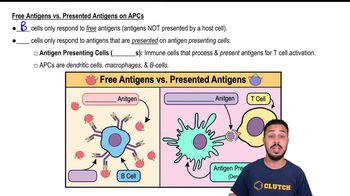
 04:11
04:11