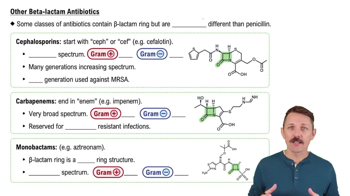
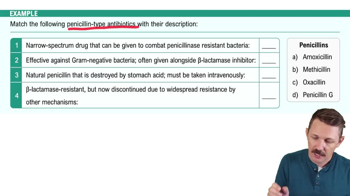
Penicillins target peptidoglycan cell-wall synthesis by binding to penicillin-binding proteins (PBPs) and blocking cross-linking, weakening the cell wall.
Why are penicillins generally more effective against Gram-positive bacteria?
Gram-positive bacteria have a thick, exposed peptidoglycan layer, allowing penicillins to easily reach PBPs and cause catastrophic wall damage.
What structural feature of Gram-negative bacteria limits penicillin effectiveness?
Gram-negative bacteria have an outer membrane that acts as a barrier, limiting penicillin entry and requiring passage through specific porins.
How do Gram-negative bacteria inactivate some penicillins before they reach PBPs?
They produce periplasmic beta-lactamases that can inactivate penicillins before the drug reaches penicillin-binding proteins.
Why do different classes of antibiotics vary in effectiveness against bacterial strains?
Each antibiotic class has a different mechanism of action and targets bacterial structures differently, affecting their effectiveness on specific strains.
What is the clinical approach to selecting an effective antibiotic for a bacterial infection?
Physicians often test bacterial samples against multiple antibiotics to identify the most effective drug for treatment.
What role do penicillin-binding proteins (PBPs) play in bacterial cells?
PBPs are enzymes involved in cross-linking peptidoglycan strands, essential for bacterial cell wall strength and integrity.
How does the outer membrane of Gram-negative bacteria affect antibiotic entry?
The outer membrane limits antibiotic entry by acting as a selective barrier, often requiring antibiotics to pass through porin channels.
What is the significance of porins in Gram-negative bacteria regarding antibiotic susceptibility?
Porins are protein channels in the outer membrane that allow certain antibiotics to enter the periplasmic space.
What is the main target of beta-lactam antibiotics like penicillins?
The main target is the peptidoglycan synthesis machinery, specifically penicillin-binding proteins involved in cell wall cross-linking.
How does the presence of beta-lactamases affect antibiotic treatment?
Beta-lactamases break down beta-lactam antibiotics, rendering them ineffective against bacteria that produce these enzymes.
Why is the bacterial cell wall a common target for antibiotics?
Because it is essential for bacterial survival and structurally different from human cells, making it a selective target.
What distinguishes Gram-positive from Gram-negative bacteria structurally?
Gram-positive bacteria have a thick peptidoglycan layer without an outer membrane, while Gram-negative bacteria have a thin peptidoglycan layer plus an outer membrane.
How does antibiotic testing guide treatment decisions?
Testing identifies which antibiotics are most effective against the specific bacterial strain, optimizing treatment success.
What is the function of peptidoglycan in bacterial cells?
Peptidoglycan provides structural support and shape to bacterial cell walls, protecting against osmotic pressure.
How do beta-lactam antibiotics like penicillins disrupt bacterial cell walls?
They inhibit PBPs, preventing cross-linking of peptidoglycan strands, leading to weakened walls and cell lysis.
What is the periplasmic space in Gram-negative bacteria?
It is the space between the outer membrane and the plasma membrane containing enzymes like beta-lactamases.
Why might some antibiotics be ineffective against Gram-negative bacteria?
Because the outer membrane blocks drug entry and beta-lactamases can inactivate drugs before they reach targets.
What determines the spectrum of activity of an antibiotic?
The antibiotic's mechanism of action and the bacterial cell structures it can access or affect.
How does bacterial cell wall structure influence antibiotic design?
Antibiotics must be designed to penetrate or bypass bacterial barriers like the outer membrane or resist degradation.
 Indietro
 04:02
04:02