Skip to main content
Microbiology
Il mio corso
Impara
Preparazione agli esami
AI Tutor
Guide di studio
Soluzioni per libri di testo
Flashcard
Esplora
Prova l'app
Il mio corso
Impara
Preparazione agli esami
AI Tutor
Guide di studio
Soluzioni per libri di testo
Flashcard
Esplora
Prova l'app
Indietro
Antimicrobial Drugs and Mechanisms in Microbiology
Puoi toccare per girare la carta.
What is the goal of antimicrobial chemotherapy?
Puoi toccare per girare la carta.
👆
What is the goal of antimicrobial chemotherapy?
To administer a drug to an infected person that destroys the infective agent without harming the host's cells.
Avanzamenti del tracciato
I pulsanti di controllo sono stati cambiati in modalità "navigazione".
1/20
Video consigliati
VideoThumbView.guidedCourse
05:33
History of Antimicrobial Drugs
637
views
24
rank
Termini in questo insieme (20)
Nascondere definizioni
What is the goal of antimicrobial chemotherapy?
To administer a drug to an infected person that destroys the infective agent without harming the host's cells.
Who discovered penicillin and what is its significance?
Alexander Fleming discovered penicillin, the first true antibiotic released from Penicillium mold.
What are beta-lactam antibiotics and their mechanism of action?
Beta-lactams contain a beta-lactam ring and inhibit enzymes that cross-link NAM subunits in bacterial cell walls, causing cell lysis.
How do semisynthetic antibiotics differ from natural antibiotics?
Semisynthetics are chemically altered natural antibiotics that are more effective, longer lasting, or easier to administer.
Name an antibiotic that interferes with mycolic acid formation and its target diseases.
Isoniazid disrupts mycolic acid formation in mycobacteria, used to treat tuberculosis and leprosy.
How do echinocandins inhibit fungal cell wall synthesis?
They inhibit the enzyme that synthesizes glucan, a key fungal cell wall polysaccharide, causing cell rupture.
Why can some antibiotics selectively inhibit bacterial protein synthesis?
Because prokaryotic ribosomes are 70S, different from eukaryotic 80S ribosomes, allowing selective targeting.
What is the role of mupirocin in protein synthesis inhibition?
Mupirocin binds isoleucyl-tRNA synthetase, preventing isoleucine loading on tRNA in Gram-positive bacteria.
How do polyenes like amphotericin B disrupt fungal membranes?
They bind to ergosterol in fungal membranes, forming pores that disrupt membrane integrity.
What is the mechanism of action of polymyxin antibiotics?
Polymyxins disrupt cytoplasmic membranes of Gram-negative bacteria, causing leakage and cell death.
How do sulfonamides act as antimetabolic agents?
They inhibit folic acid synthesis by competing with para-aminobenzoic acid (PABA), blocking nucleotide production.
What is the therapeutic index (TI) and why is it important?
TI is the ratio of toxic dose to effective dose; a higher TI means a safer drug with a wider margin of safety.
What is the Kirby-Bauer test used for?
It measures antibiotic susceptibility by observing zones of inhibition around antibiotic discs on bacterial lawns.
What does the minimum inhibitory concentration (MIC) test determine?
The smallest concentration of a drug that visibly inhibits bacterial growth.
Why is selective toxicity important in antimicrobial drugs?
It ensures the drug targets pathogens without harming host cells by exploiting differences in structure or metabolism.
What causes bacterial resistance to penicillin?
Production of penicillinase (beta-lactamase) enzymes that destroy the beta-lactam ring of penicillin.
List two mechanisms bacteria use to resist antimicrobial drugs.
Producing enzymes that deactivate drugs and pumping drugs out of the cell before they act.
What is the difference between narrow-spectrum and broad-spectrum antibiotics?
Narrow-spectrum antibiotics target a limited group of bacteria; broad-spectrum target many types.
How can misuse of antibiotics lead to superinfections?
Broad-spectrum antibiotics kill normal flora, reducing microbial antagonism and allowing resistant pathogens to proliferate.
What is the significance of reverse transcriptase inhibitors in antiviral therapy?
They block the enzyme HIV uses for replication, without harming humans who lack reverse transcriptase.
 IndietroIndietro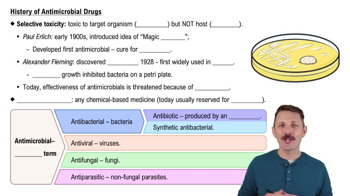
 05:33
05:33