Skip to main content
Microbiology
Il mio corso
Impara
Preparazione agli esami
AI Tutor
Guide di studio
Soluzioni per libri di testo
Flashcard
Esplora
Prova l'app
Il mio corso
Impara
Preparazione agli esami
AI Tutor
Guide di studio
Soluzioni per libri di testo
Flashcard
Esplora
Prova l'app
Indietro
Antimicrobial Drugs in Microbiology
Puoi toccare per girare la carta.
What are antimicrobial drugs?
Puoi toccare per girare la carta.
👆
What are antimicrobial drugs?
Therapeutic compounds that kill microbes or inhibit their growth.
Avanzamenti del tracciato
I pulsanti di controllo sono stati cambiati in modalità "navigazione".
1/23
Video consigliati
VideoThumbView.guidedCourse
05:33
History of Antimicrobial Drugs
884
views
30
rank
Termini in questo insieme (23)
Nascondere definizioni
What are antimicrobial drugs?
Therapeutic compounds that kill microbes or inhibit their growth.
Name the four categories of antimicrobial drugs based on pathogen type.
Antibacterial, antiviral, antifungal, and antiparasitic drugs.
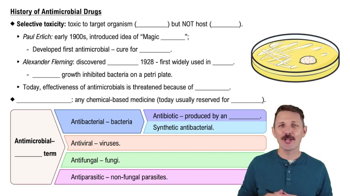
Who discovered penicillin and when?
Alexander Fleming in 1928.
What is the difference between broad-spectrum and narrow-spectrum antibacterial drugs?
Broad-spectrum drugs target both Gram-negative and Gram-positive bacteria; narrow-spectrum drugs target a limited range.
What is empiric therapy in antimicrobial treatment?
Starting treatment before definitive pathogen identification to protect the patient.
Define bacteriostatic and bactericidal drugs.
Bacteriostatic drugs prevent bacterial growth; bactericidal drugs kill bacteria.
What factors can influence whether a drug is bactericidal or bacteriostatic?
Pathogen type, dose, length of regimen, pathogen load, and route of administration.
What are antibiotics, synthetic antimicrobials, and semisynthetic antimicrobials?
Antibiotics are natural compounds; synthetic antimicrobials are chemically made; semisynthetic are chemically modified natural antibiotics.
What is selective toxicity in antimicrobial drugs?
The ability of a drug to target microbes without harming the host.
How is the therapeutic index calculated?
Therapeutic index = \(\frac{\text{Maximum safe dose}}{\text{Minimum effective dose}}\).
Why is therapeutic drug monitoring (TDM) important?
To ensure patient safety and assess drug effectiveness by measuring drug levels and patient parameters.
Which organs are most susceptible to drug toxicity?
Kidneys (nephrotoxic effects) and liver (hepatotoxic effects).
What are the common routes of antimicrobial drug administration?
Oral and parenteral (intravenous, intramuscular, subcutaneous) administration.
What determines the frequency of drug administration?
The drug's half-life, the time it takes for half the dose to be eliminated.
What is the Kirby-Bauer test used for?
Determining bacterial susceptibility to antimicrobial drugs by measuring zones of inhibition on agar plates.
What does a zone of inhibition indicate in susceptibility testing?
The area where bacteria cannot grow due to the antimicrobial drug's effect.
Define antimicrobial resistance.
When microbes are not affected by drugs intended to inhibit or kill them.
What is a superinfection?
An infection caused by resistant microbes that thrive after susceptible microbes are eliminated.
What is intrinsic resistance?
Natural resistance of microbes to certain antimicrobial drugs.
Give examples of intrinsic resistance in microbes.
Mycoplasma pneumoniae lacks a cell wall; Clostridioides difficile forms resistant endospores.
What is acquired resistance?
Resistance gained through genetic mutation or acquisition of resistance genes.
List the three main ways microbes evade antimicrobial drugs.
Altering the drug's target, inactivating the drug, and reducing drug concentration inside the cell.
How can human behavior accelerate antimicrobial resistance?
Through unregulated antibiotic use, antimicrobials in animal feed, inappropriate prescriptions, and noncompliance with dosing.
 IndietroIndietro
 05:33
