 Indietro
Bacterial Growth, Enumeration, and Culture Media

 08:59
08:59
Termini in questo insieme (20)
Bacterial growth refers to the increase in the number of bacterial cells, not the size of individual cells.
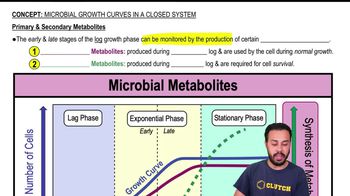
The phases are lag phase, log (exponential) phase, stationary phase, and death phase.
Cells adapt to new conditions, synthesize enzymes, but do not divide significantly.
Cells divide at a constant and rapid rate, leading to exponential increase in cell number.
Growth rate slows and stabilizes as nutrients deplete and waste accumulates; cell division equals cell death.
Cells die at an exponential rate due to lack of nutrients and toxic conditions.
Bacterial enumeration is the process of counting the number of bacteria in a sample.
Plate count method and direct microscopic count.
It involves spreading a diluted sample on agar plates and counting colony-forming units (CFUs) after incubation.
One CFU represents one viable bacterial cell or a group of cells that formed a colony.
To reduce bacterial concentration to a countable range on agar plates.
Counting bacteria directly under a microscope using a specialized counting chamber.
Culture media are nutrient solutions or gels used to grow microorganisms in the lab.
Liquid (broth), solid (agar), and semi-solid media.
Selective media inhibit growth of some microbes; differential media distinguish microbes based on biochemical traits.
MacConkey agar, which selects for Gram-negative bacteria.
Blood agar, which differentiates bacteria based on hemolysis patterns.
Agar is a solidifying agent that is not metabolized by most bacteria and remains solid at incubation temperatures.
Temperature, pH, oxygen availability, nutrient composition, and moisture.
The time required for a bacterial population to double during the log phase.