 Indietro
Chapter 5: Genetics
 03:55
03:55
Termini in questo insieme (21)
Genotype is the genetic makeup of an organism, while phenotype is the observable physical or physiological traits influenced by the genotype.
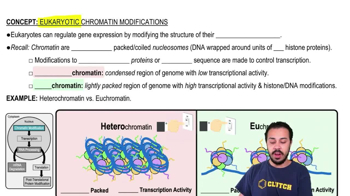
Prokaryotes have few, usually circular chromosomes in the nucleoid region, organized by histone-like proteins. Eukaryotes have many linear chromosomes in a nucleus, organized by histones.
A nucleotide consists of a phosphate group, a sugar (deoxyribose in DNA, ribose in RNA), and a nitrogenous base (A, T/U, G, C).
In DNA, adenine (A) pairs with thymine (T), and guanine (G) pairs with cytosine (C) via hydrogen bonds.
DNA strands have chemical directionality: one end has a 5' phosphate group and the other a 3' hydroxyl group; DNA is synthesized 5' to 3'.
DNA is double-stranded with strands running in opposite directions: one 5' to 3', the other 3' to 5', allowing complementary base pairing.
RNA contains ribose sugar, uracil instead of thymine, is usually single-stranded, and can fold into complex structures.
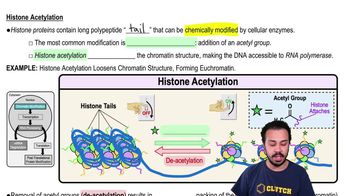
Genetic information flows from DNA to RNA (transcription) and from RNA to protein (translation).
Helicase unwinds DNA; primase synthesizes RNA primers; DNA polymerase III synthesizes new DNA; DNA polymerase I replaces RNA primers; ligase seals DNA fragments; gyrase/topoisomerase relieve supercoiling.
Leading strand is synthesized continuously toward the replication fork; lagging strand is synthesized discontinuously away from the fork in Okazaki fragments.
RNA primers provide a 3' OH group for DNA polymerase to begin DNA synthesis.
Initiation: RNA polymerase binds promoter; Elongation: RNA strand synthesized 5' to 3'; Termination: RNA polymerase detaches at termination sequence.
mRNA carries codons for amino acids; tRNA carries amino acids and has anticodons; rRNA forms ribosomes.
Introns are removed and exons joined by spliceosomes to produce mature mRNA for translation.
64 codons encode 20 amino acids plus start and stop signals; the code is redundant, protecting against mutations.
Initiation: ribosome assembles at start codon; Elongation: amino acids added; Termination: ribosome releases protein at stop codon.
Operons are clusters of genes controlled by a single promoter and operator; inducible operons are off by default, repressible operons are on by default.
Bacteria communicate via chemical signals to regulate gene expression based on population density, important for biofilm formation.
Substitution changes one base; insertion adds bases; deletion removes bases; effects include silent, missense, nonsense, and frameshift mutations.
Excision repair removes damaged DNA sections; DNA polymerase fills gaps; ligase seals backbone; proofreading by DNA polymerase reduces errors.
Includes conjugation (plasmid transfer via pilus), transformation (uptake of free DNA), transduction (phage-mediated DNA transfer), and transposons (mobile genetic elements).