 Indietro
chapter 7
 07:36
07:36
Termini in questo insieme (20)
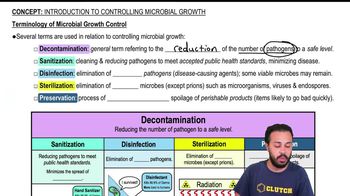
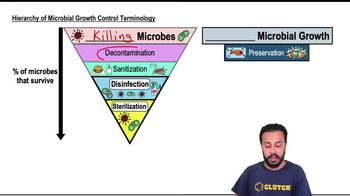
Sterilization is the removal and destruction of all microbial life, including endospores.
Disinfection is the destruction of harmful microorganisms on inanimate surfaces or environments.
Antisepsis is the destruction of harmful microorganisms from living tissue.
Degerming is the mechanical removal of microbes from a limited area, such as skin around an injection site.
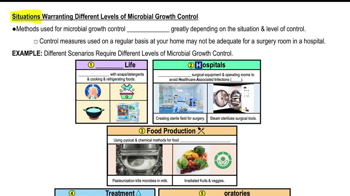
Sanitization lowers microbial counts on eating utensils or surfaces to safe public health levels.
Biocide or germicide refers to treatments that kill microbes.
Bacteriostasis is the inhibition of microbial growth without killing the microbes.
Asepsis is the absence of significant contamination by microbes.
Microbial death occurs exponentially; a constant percentage of the population dies per unit time, shown as a straight line on a logarithmic scale.
Factors include the number of microbes, environment (organic matter, temperature, biofilms), time of exposure, and microbial characteristics (e.g., endospores).
They damage the plasma membrane causing leakage, damage proteins (enzymes), and damage nucleic acids.
Moist heat denatures proteins and is faster (e.g., autoclaving), while dry heat kills by oxidation and requires higher temperatures and longer times.
Steam under pressure at 121°C and 15 psi for 15 minutes kills all organisms except prions and endospores.
Pasteurization reduces spoilage organisms and pathogens but does not sterilize; UHT pasteurization sterilizes milk by heating to 140°C for 4 seconds.
Filtration removes microbes from heat-sensitive liquids or air using membrane filters (0.22 μm) or HEPA filters (0.3 μm).
Low temperatures have a bacteriostatic effect by slowing metabolism; includes refrigeration, deep-freezing, and lyophilization.
Ionizing radiation creates hydroxyl radicals that damage DNA; nonionizing UV radiation causes thymine dimers in DNA, disrupting replication.
It evaluates disinfectant effectiveness by exposing bacteria-coated cylinders to disinfectants and then culturing to check survival.
Filter paper disks soaked in chemicals are placed on bacterial cultures; zones of inhibition indicate antimicrobial effectiveness.
Concentration of disinfectant, presence of organic matter, pH, temperature, and time of exposure.