Key difference between prokaryotic and eukaryotic cells
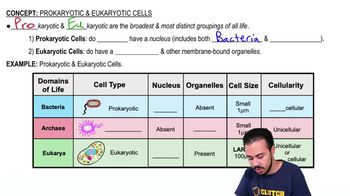
Prokaryotic cells lack membrane-enclosed organelles including a nucleus, while eukaryotic cells have a membrane-bound nucleus and other organelles.
What is peptidoglycan and where is it found?
Peptidoglycan is a polymer of NAG and NAM sugars with amino acid chains, found in the cell walls of prokaryotic bacteria but not in eukaryotic cell walls.
Basic shapes of bacterial cells
The three basic bacterial shapes are coccus (spherical), bacillus (rod-shaped), and spiral (twisted).
Functions of bacterial glycocalyx
The glycocalyx (capsule or slime layer) protects pathogens from phagocytosis, enables adherence to surfaces, prevents desiccation, and may provide nutrients.
Structure and function of bacterial flagella
Flagella are long filamentous appendages with a filament, hook, and basal body that rotate to push the cell, enabling motility and taxis.
What is bacterial taxis?
Taxis is movement in response to stimuli: positive taxis is movement toward an attractant, and negative taxis is movement away from a repellent.
Role of H antigen in bacteria
The flagellar protein H antigen is used to distinguish serovars of gram-negative bacteria.
What are axial filaments and which bacteria have them?
Axial filaments (endoflagella) wrap around spiral-shaped spirochetes and enable their unique corkscrew motility.
Difference between fimbriae and pili
Fimbriae help bacteria adhere to surfaces; pili are involved in twitching motility and DNA transfer.
Composition of bacterial cell walls
Bacterial cell walls are made of peptidoglycan, a polymer of NAG and NAM sugars linked by short amino acid chains.
Differences between gram-positive and gram-negative cell walls
Gram-positive walls have many peptidoglycan layers and teichoic acids; gram-negative walls have a thin peptidoglycan layer and an outer membrane with lipopolysaccharides.
Function of the outer membrane in gram-negative bacteria
The outer membrane protects against phagocytosis, penicillin, lysozyme, and chemicals; it contains porins for molecule passage and lipopolysaccharides as endotoxins.
What is the role of lipopolysaccharide (LPS) in gram-negative bacteria?
LPS consists of O polysaccharides that act as antigens and lipid A, which is an endotoxin causing toxic effects.
How does the Gram stain differentiate bacteria?
Crystal violet–iodine complex binds peptidoglycan; decolorizer removes outer membrane in gram-negative bacteria washing out the dye, differentiating gram-positive (purple) and gram-negative (pink).
What are atypical bacterial cell walls?
Some bacteria like Mycoplasma lack cell walls; Archaea have pseudomurein instead of peptidoglycan; acid-fast bacteria have mycolic acid layers.
Role of penicillin in bacterial cell wall synthesis
Penicillin interferes with the synthesis of peptidoglycan, weakening the bacterial cell wall and causing cell lysis.
Structure and function of the plasma membrane in bacteria
The plasma membrane is a lipid bilayer with proteins, selectively permeable, containing enzymes for metabolism and energy production.
Types of transport across bacterial plasma membranes
Transport includes passive diffusion, facilitated diffusion, osmosis, active transport (energy-dependent), and group translocation (chemical modification during transport).
What is the nucleoid in bacteria?
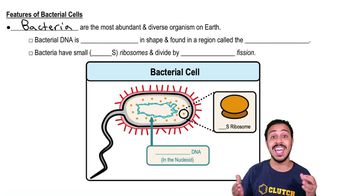
The nucleoid is the region containing the bacterial chromosome DNA; bacteria may also have plasmids, which are extrachromosomal circular DNA molecules.
Characteristics of bacterial ribosomes
Bacterial ribosomes are 70S, composed of rRNA and protein, and are the site of protein synthesis.
What are bacterial endospores?
Endospores are dormant, resistant structures formed by some bacteria to survive adverse environmental conditions.
Differences between eukaryotic and prokaryotic flagella and cilia
Eukaryotic flagella are few and long; cilia are numerous and short. Both have a 9+2 microtubule arrangement and are used for motility; cilia also move substances along cell surfaces.
Composition of eukaryotic cell walls
Algal cell walls contain cellulose; fungal walls contain chitin; yeast walls have glucan and mannan; animal cells lack walls but have a glycocalyx.
Unique features of the eukaryotic plasma membrane
Eukaryotic plasma membranes have phospholipid bilayers with proteins, carbohydrates, and sterols; they perform passive and active transport plus endocytosis.
Functions of the rough and smooth endoplasmic reticulum
Rough ER has ribosomes for protein synthesis and transport; smooth ER synthesizes lipids.
Role of mitochondria and chloroplasts in eukaryotic cells
Mitochondria produce ATP and contain 70S ribosomes and DNA; chloroplasts perform photosynthesis and also have 70S ribosomes and DNA.
What is the endosymbiotic theory?
The theory states eukaryotic cells evolved from symbiotic prokaryotes living inside other prokaryotic cells.
 Indietro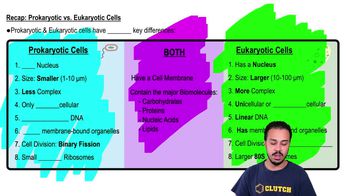
 04:26
04:26