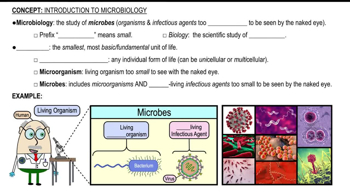
A microbe or microorganism is a tiny living organism too small to be seen with the unaided eye.
Relative size of viruses and bacteria
A typical virus measures about 100 nm, which is 10 times smaller than a typical bacterium (~1 μm).
Roles of microbes in the environment
Microbes decompose organic waste, generate oxygen by photosynthesis, incorporate nitrogen gas into organic compounds, and produce food and chemical products.
Definition of microbiome
A microbiome is a characteristic microbial community occupying a defined habitat, including the microorganisms and their environment.
Difference between microbiome and microbiota
Microbiota refers to all microorganisms living stably on/in a habitat, while microbiome includes the community plus their environment and activity.
Resident vs transient microbiota
Resident microbiota colonize the body indefinitely; transient microbiota colonize temporarily.
Importance of the human microbiome
The microbiome aids immune development, pathogen resistance, nutrition (e.g., vitamin K2 production), and influences behavior and mental health.
Taxonomy and classification
Taxonomy is the classification, description, identification, and naming of living organisms, established by Carolus Linnaeus with hierarchical ranks.
Three domains of life
The three domains are Bacteria, Archaea, and Eukarya, distinguished by rRNA sequences and cellular features.
Characteristics of prokaryotes
Prokaryotes are single-celled organisms without a nuclear membrane, including bacteria and archaea, with simpler cell structures.
Differences between Bacteria and Archaea
Bacteria have ester-linked membrane lipids and bacterial rRNA; Archaea have ether-linked lipids and unique rRNA sequences.
Viruses and the tree of life
Viruses are not considered alive, have independent genetic lineages, and do not fit into the traditional tree of life.
Binomial naming system
Organisms are named by genus (capitalized) and species (lowercase), italicized in print, e.g., Escherichia coli.
Examples of binomial names
Names can be descriptive (e.g., Staphylococcus aureus), honor scientists (e.g., Escherichia coli), or reference geographic locations.
Microbial roles in food production
Microbes like Lactobacillus and Penicillium species are used in yogurt, cheese, soy sauce, bread, and beer production.
Theory of spontaneous generation
The disproven idea that living organisms arise from nonliving matter; replaced by germ theory and cell theory.
Germ theory of disease
Diseases are caused by microbes; established by scientists like Pasteur and Koch through experiments and postulates.
Koch's postulates
A set of criteria to link a specific microbe to a specific disease.
Microbial ecology and human welfare
Microbes recycle vital elements, treat sewage, clean pollutants, control insect pests, and are used in biotechnology.
Biofilms
Complex microbial communities attached to surfaces; can be beneficial (protect mucous membranes) or harmful (cause infections, resist antibiotics).
Emerging infectious diseases
New or increasing diseases caused by factors like antibiotic resistance, global travel, and environmental changes.
 Indietro
 03:36
03:36