 Indietro
Innate and Adaptive Immunity Basics
 05:52
05:52
Termini in questo insieme (20)
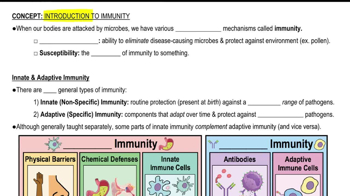
Innate immunity is the body's first line of defense, providing immediate, nonspecific protection against pathogens.
Adaptive immunity is specific, slower to respond, and involves memory for faster response upon re-exposure to the same pathogen.
Normal microbiota limit pathogen growth by competing for nutrients and space, and can stimulate immune responses.
Lysozyme is an enzyme that breaks down bacterial cell walls and is found in tears, saliva, and mucus.
Antimicrobial peptides disrupt microbial membranes and help control infections as part of innate immunity.
Lymph is fluid collected from tissues, filtered through lymph nodes, and returned to the bloodstream.
Primary lymphoid tissues (bone marrow and thymus) are where lymphocytes develop and mature.
Secondary lymphoid tissues (lymph nodes, spleen) are sites where immune responses are initiated.
Leukocytes are divided into granulocytes (with granules) and agranulocytes (without granules).
Monocytes circulate in blood; macrophages are tissue-resident phagocytes; dendritic cells present antigens to lymphocytes.
Lymphocytes include B cells, T cells, and natural killer (NK) cells, each with distinct immune roles.
Leukocytes perform phagocytosis, produce signaling molecules, and coordinate immune responses in second-line defense.
Inflammation functions to destroy pathogens, limit spread, and repair tissue.
The phases are vasodilation, phagocyte migration and phagocytosis, and tissue repair.
The signs are redness, heat, swelling, and pain, caused by increased blood flow and immune activity.
Chronic inflammation is prolonged, can cause tissue damage, and involves persistent immune activation.
Fever is an elevated body temperature that inhibits pathogen growth and enhances immune function.
Fever is triggered by pyrogens that reset the hypothalamic thermostat to a higher temperature.
Fever treatment includes antipyretics to lower temperature and addressing the underlying cause.
Fever patterns include continuous, intermittent, remittent, and relapsing, describing temperature fluctuations.