Indietro

Innate Immune Response - Microbiology

I pulsanti di controllo sono stati cambiati in modalità "navigazione".
1/20
  • What are the three lines of defense in immunity?

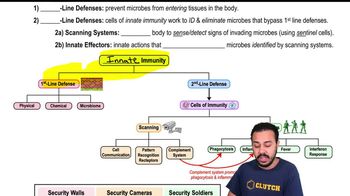
    First line: Intact skin, mucous membranes, normal microbiota, mechanical expulsion.
    Second line: Natural killer cells, phagocytes, inflammation, fever, antimicrobial substances.
    Third line: Specialized lymphocytes (T and B cells), antibodies.
  • What characterizes innate immunity?

    Innate immunity is immediate, nonspecific, and does not require prior exposure to pathogens.
  • What are the main layers of the skin involved in barrier defense?

    The skin has the epidermis (outer layer) and dermis (inner layer). The epidermis includes dead corneal cells that shed to remove pathogens.
  • What role do tight junctions play in skin defense?

    Tight junctions between epithelial cells restrict movement of microbes between cells, maintaining barrier integrity.
  • What antimicrobial substances are secreted by the skin?

    Sweat and sebum contain salt (NaCl), lysozyme, defensins, dermicidins, and fatty acids that inhibit microbial growth.
  • What are defensins and how do they work?

    Defensins are antimicrobial peptides that form pores in microbial cytoplasmic membranes, disrupting their integrity.
  • What is the function of mucous membranes in innate defense?

    Mucous membranes trap microbes with mucus secreted by goblet cells and move them outward via cilia to prevent infection.
  • How do lacrimal secretions protect the eye?

    Tears contain lysozyme, an enzyme that breaks down bacterial cell walls, protecting the eye from infection.
  • Name mechanical expulsion mechanisms in innate immunity.

    Coughing, sneezing, peristalsis, defecation, urination, menstrual flow, vomiting, and diarrhea help clear microbes from the body.
  • How do acidic secretions contribute to innate defense?

    Acidic secretions like gastric acid, urine, and vaginal secretions lower pH to inhibit microbial growth.
  • What is the role of normal microbiota in innate immunity?

    Normal microbiota occupy attachment sites, compete for nutrients, alter environment chemistry, and stimulate other innate defenses.
  • What are the major phagocytes in innate immunity?

    Macrophages, neutrophils, eosinophils, and dendritic cells perform phagocytosis to engulf and destroy pathogens.
  • What are the four stages of phagocytosis?

    1. Chemotaxis - attraction to microbes.
    2. Adherence - attachment to microbes.
    3. Ingestion - engulfment.
    4. Digestion - destruction inside phagolysosome.
  • How do some microbes evade phagocytosis?

    Microbes evade by inhibiting adherence (capsules), killing phagocytes (leukocidins), escaping phagosomes, or surviving in phagolysosomes.
  • What triggers natural killer (NK) cell activity?

    NK cells kill cells with reduced MHC class I expression, such as virus-infected or tumor cells, by releasing cytotoxic granules.
  • What are Toll-like receptors (TLRs) and their function?

    TLRs recognize pathogen-associated molecular patterns (PAMPs), triggering inflammatory mediators, adaptive immunity stimulation, and apoptosis.
  • What is the role of interferons in innate immunity?

    Interferons (IFN-α, IFN-β) induce antiviral proteins in cells to inhibit viral replication; IFN-γ activates phagocytes.
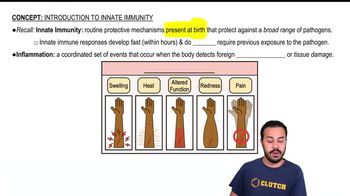
  • What chemical mediators are released during inflammation?

    Histamine, kinins, prostaglandins, and leukotrienes cause vasodilation, increased vessel permeability, and attract phagocytes.
  • What are the four classic symptoms of inflammation?

    Redness (rubor), heat (calor), swelling (tumor), and pain (dolor) result from increased blood flow, chemical release, and fluid leakage.
  • What is the complement system and its functions?

    A set of 26 proteins that, when activated, lyse pathogens, promote inflammation, and enhance adaptive immunity through a cascade.