 Indietro
Innate Immunity: Second Line of Defense - Microbiology
 05:52

Termini in questo insieme (21)
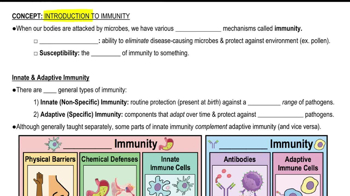
1. Barrier (physical and chemical barriers)
2. Innate immunity (non-specific, same from birth)
3. Adaptive immunity (specific, changes over life)
Multiple layers of tightly packed cells in the epidermis, shedding of dead skin cells, and collagen fibers in the dermis providing strength and resistance to abrasions.
They trap microbes with sticky mucus, use ciliated cells to move mucus, continually shed cells, and contain antimicrobial peptides and lysozyme.
Produces and drains tears that physically wash microbes from the eye surface and contain lysozyme to destroy bacterial cell walls.
Normal microbiota compete with pathogens by taking up space, consuming nutrients, creating unfavorable environments, producing antimicrobials, and stimulating the immune system.
Leukocytes are white blood cells involved in defense, originating from blood stem cells in bone marrow.
Neutrophils, eosinophils, basophils, monocytes/macrophages, and dendritic cells.
1. Chemotaxis
2. Adhesion
3. Ingestion
4. Maturation
5. Killing
6. Elimination
Phagocytes migrate toward microbial products, damaged cells, and chemical signals using pseudopodia.
Coating of pathogens with proteins (opsonins) that enhance phagocyte binding and increase phagocytosis efficiency.
Lysosomes fuse with the phagosome to form a phagolysosome, adding digestive enzymes and toxic oxygen forms to kill pathogens.
Interferons are proteins released by infected cells that inhibit viral spread by triggering antiviral protein production in neighboring cells.
AVPs become activated by viral infection, stop host cell transcription and translation, destroy mRNA, and inhibit viral replication, leading to host cell death.
Type I (alpha and beta) produced early by infected cells to inhibit viruses; Type II (gamma) produced by Helper T-cells to regulate immune responses.
A set of serum proteins that enhance phagocytosis, trigger inflammation, and form membrane attack complexes to lyse pathogens.
Classical pathway (antibody-dependent), alternative pathway (antibody-independent), and lectin pathway (mannose-binding).
A structure formed by complement proteins that creates holes in pathogen membranes, causing cell lysis.
Dilation and increased permeability of blood vessels, migration of phagocytes, redness, heat, swelling, pain, and tissue repair.
Acute inflammation is rapid, short-lived, and beneficial; chronic inflammation is long-lasting and can cause tissue damage.
Pyrogens from microbes and phagocytes trigger hypothalamus to raise body temperature, enhancing immune cell activity and inhibiting microbial growth.
Denaturation of critical proteins, inhibited nerve impulses, hallucinations, coma, and death.