 Indietro
Introduction to Microbiology
 03:36
03:36

Termini in questo insieme (29)
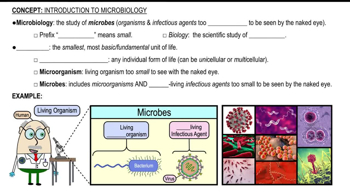
Microbiology is the study of microorganisms or microbes, which are often invisible to the naked eye.
Cellular microorganisms like bacteria, archaea, fungi, protists, helminths, and nonliving entities like viruses and prions.
Unicellular organisms without a nucleus, including bacteria and archaea, evolved about 3.5 billion years ago.
Cells with a nucleus, including all multicellular organisms and some unicellular microbes like amoebae and yeast.
Period (1850–1920) marked by innovations in microscopes, microbial isolation, and cultivation techniques.
The disproven theory that life arises from nonliving matter.
Biogenesis is responsible for life propagation; disproved spontaneous generation using S-neck flask experiment.
The concept that microbes cause infectious diseases, supported by Robert Koch's work.
Criteria to link a specific microbe to a disease: presence in all cases, isolation, reproduction of disease in host, and re-isolation.
Procedures like hand washing, sterilizing instruments, and decontaminating surfaces to prevent infection and contamination.
A two-name system for naming organisms: genus (capitalized) and species (lowercase), both italicized.
Domain, Kingdom, Phylum, Class, Order, Family, Genus, Species.
Bacteria (prokaryotic), Archaea (prokaryotic, often extremophiles), and Eukarya (eukaryotic organisms).
Cells sharing physical traits, at least 70% DNA similarity, and 97% identical 16S rRNA sequences.
A genetic variant of a species, often designated by numbers or letters after the species name.
Sticky microbial communities attached to surfaces, protected by a matrix, often resistant to antibiotics.
Microbes that normally live on or in the human body, aiding immune function, vitamin production, and digestion.
Colonization begins during birth and early life, influenced by delivery mode and feeding method.
Opportunistic pathogens can cause infections, e.g., yeast infections after antibiotic use.
To provide nutrients for microbial growth in the lab, available as broths, plates, slants, and deeps.
Methods to prevent contamination during microbial culturing, including sterile media and instruments.
A method to isolate individual microbial colonies on agar plates for study.
To increase contrast and make cells easier to see under a microscope.
To differentiate bacteria into Gram-positive (purple) and Gram-negative (pink) based on cell wall structure.
A technique to identify bacteria with waxy cell walls, like Mycobacterium, which retain red dye after acid wash.
The ability to distinguish two points as separate; compound light microscopes resolve about 200 nm.
To match the refractive index of glass and prevent light scattering, improving image clarity at 100× objective.
Transmission Electron Microscopes (TEM) for internal structures and Scanning Electron Microscopes (SEM) for surface images.
Uses fluorescent dyes and UV light to visualize specific structures or microbes with emitted visible light.