 Indietro
Introduction to Microbiology
 03:36
03:36

Termini in questo insieme (30)
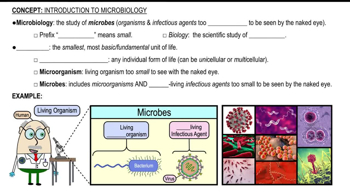
Microbiology is the study of microbes, including organisms and infectious agents too small to be seen with the naked eye.
Microorganism: living organism too small to see with the naked eye.
Microbe: includes microorganisms and non-living infectious agents too small to see.
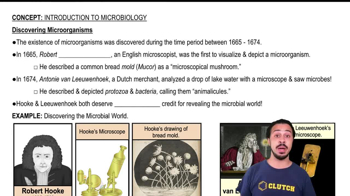
Antonie van Leeuwenhoek first observed microorganisms in 1674 and called them animalicules (little animals).
Taxonomy is the branch of science that classifies, identifies, and names organisms using hierarchical categories.
The three domains are Bacteria, Archaea, and Eukarya.
Prokaryotes are unicellular organisms without a nucleus; eukaryotes have cells with a nucleus and can be unicellular or multicellular.
Kingdoms in Eukarya include Animalia, Plantae, Fungi, and Protista.
Organisms are categorized as autotrophs (make their own food), heterotrophs (consume others), or decomposers (consume dead matter).
Developed by Carl Linnaeus, it uses two Latin parts: Genus (capitalized) and species (lowercase), both italicized or underlined.
Strains are genetic variants within a species, showing minor differences.
Bacteria are unicellular, prokaryotic organisms with cell walls made of peptidoglycan, reproducing by binary fission.
Archaea are prokaryotes with unique rRNA sequences and cell walls lacking peptidoglycan; many are extremophiles.
Eukaryotes have membrane-bound nuclei and include fungi, algae, protozoa, and helminths.
Fungi are eukaryotes ranging from unicellular yeasts to multicellular molds; they have chitin cell walls and do not perform photosynthesis.
Algae are photosynthetic eukaryotes, unicellular or multicellular, with cellulose cell walls, found in aquatic or moist habitats.
Protozoa are unicellular eukaryotes without cell walls, often motile and ingest organic material for food.
Helminths are parasitic worms; not microscopic but their eggs and larvae are, so they are studied in microbiology.
Acellular infectious agents like viruses, viroids, and prions lack cellular structure and cannot reproduce independently.
Viruses are obligate intracellular parasites made of DNA or RNA inside a protein coat; they infect all life domains.
Viroids are small, circular, single-stranded RNA molecules that infect plants and cause disease.
Prions are misfolded proteins that cause normal proteins to misfold, leading to neurodegenerative diseases.
Microorganisms are used to produce food (bread, beer, yogurt), antibiotics, biofuels, insecticides, and plastics.
They fix nitrogen, degrade cellulose, and perform bioremediation to clean pollutants.
They share fundamental metabolic and genetic features with complex organisms and grow quickly and inexpensively.
The normal microbiota are trillions of microbes living on and in humans, aiding health by competing with pathogens.
A procedure to ask questions, test ideas, and build scientific knowledge through observation, hypothesis, experimentation, and analysis.
Hypothesis: testable explanation.
Prediction: expected outcome.
Theory: well-supported, testable explanation.
Independent variable: factor changed by the experimenter.
Dependent variable: factor measured or observed.
False positive: incorrect indication of a positive result.
False negative: incorrect indication of a negative result.
Positive control: group expected to show a positive result.
Negative control: group expected to show no effect.