Bacteria and Archaea are the two prokaryotic domains.
How do prokaryotic cells differ from eukaryotic cells?
Prokaryotes are unicellular, lack a membrane-bound nucleus, and lack membrane-bound organelles.
Why are prokaryotes generally small in size?
Small size allows for a high surface area-to-volume ratio, facilitating efficient nutrient uptake and waste elimination.
Define monomorphic and pleomorphic bacteria.
Monomorphic bacteria have one shape; pleomorphic bacteria can take on different forms, aiding survival and transmission.
Name common prokaryotic shapes.
Common shapes include bacilli (rod-shaped), cocci (spherical), vibrio (comma-shaped), stella (star-shaped), coccobacilli (ovoid), and spirochetes (spiral-shaped).
What are common prokaryotic cell arrangements?
Arrangements include diplococci (pairs), streptococci (chains), staphylococci (clusters), diplobacilli (paired rods), streptobacilli (chains of rods), and palisade (clusters of rods).
Describe the process of binary fission.
DNA is copied, cell grows, chromosomes separate, septum forms at midpoint, and two daughter cells separate.
What is the structure and function of the prokaryotic plasma membrane?
A thin, flexible phospholipid bilayer that acts as a selective barrier controlling substance entry and exit.
How do membrane proteins function in prokaryotes?
They act as transporters, anchors, receptors, and enzymes, and help detect environmental changes.
What factors affect membrane fluidity?
Temperature and fatty acid content; warmer temperatures and unsaturated fatty acids increase fluidity.
How do bacterial and archaeal plasma membranes differ?
Bacteria have linear fatty acids in bilayers; archaea have long-branched fatty acids and can form lipid monolayers.
What is the main component of bacterial cell walls?
Peptidoglycan is the core component of bacterial cell walls.
How do Gram-positive and Gram-negative cell walls differ?
Gram-positive have a thick peptidoglycan layer and no outer membrane; Gram-negative have a thin peptidoglycan layer, outer membrane with lipopolysaccharide.
What color do Gram-positive and Gram-negative bacteria stain?
Why are Gram-negative bacteria often harder to kill with chemicals?
Their outer membrane acts as a selective barrier protecting against lysozyme, drugs, detergents, and disinfectants.
What is acid-fast staining used to detect?
It detects mycolic acid, a waxy lipid in cell walls of acid-fast bacteria like Mycobacterium and Nocardia.
What are the main types of passive transport in prokaryotes?
Simple diffusion for small noncharged molecules and facilitated diffusion using channel or carrier proteins.
Define osmosis and its effects on bacterial cells in different solutions.
Osmosis is water movement from low to high solute concentration. In hypertonic solutions, cells lose water; hypotonic, cells gain water; isotonic, no net water movement.
What are the main types of active transport in prokaryotes?
Primary active transport uses ATP; secondary active transport uses ion gradients (symport and antiport); phosphotransferase systems modify transported substances.
What are flagella and their function in prokaryotes?
Flagella are protein filaments made of flagellin that rotate like propellers to enable motility.
Describe the different flagella arrangements.
Monotrichous (single), lophotrichous (tuft at one pole), amphitrichous (flagella at both poles), peritrichous (all over surface).
What are periplasmic flagella and their role?
Located between plasma membrane and cell wall, they enable spirochetes to move in a corkscrew motion.
What are fimbriae and pili?
Fimbriae are short, bristle-like structures for adhesion; pili are longer, rigid, fewer, used for adhesion, movement, and gene transfer.
What is the glycocalyx and its types?
A sticky carbohydrate layer; slime layer is loose and unorganized, capsule is well-organized and tightly associated.
What is the nucleoid in prokaryotes?
The nucleoid is the region containing the single, circular chromosome of prokaryotic DNA.
Describe prokaryotic ribosomes.
70S ribosomes made of 50S large and 30S small subunits; synthesize proteins by linking amino acids.
What is the function of the prokaryotic cytoskeleton?
Composed of protein filaments, it provides structure and support to the cell.
What are inclusion bodies?
Distinct collections of substances inside cells used for storage, e.g., carboxysomes and magnetosomes.
What are endospores and why are they important?
Metabolically inactive, highly resistant structures formed by some bacteria to survive harsh conditions.
Name medically important spore-forming bacteria.
Genera Bacillus, Clostridium, and Clostridioides, including species causing anthrax, tetanus, botulism, gas gangrene, and severe diarrhea.
 Indietro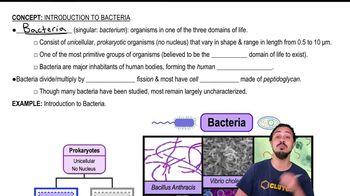
 06:18
06:18