Include temperature, pH, and osmotic pressure essential for microbial survival and reproduction.
Chemical requirements for microbial growth
Include carbon, nitrogen, sulfur, phosphorus, trace elements, oxygen, and organic growth factors.
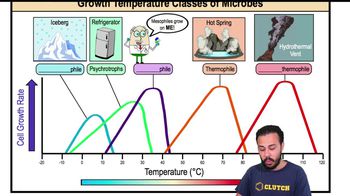
Minimum, optimum, and maximum growth temperatures
Minimum is the lowest temperature a species grows, optimum is the best growth temperature, and maximum is the highest temperature allowing growth.
Microbial temperature groups
Psychrophiles (-10 to 20°C), Mesophiles (10 to 50°C), Thermophiles (40 to 72°C), and Hyperthermophiles (65 to 110°C).
pH range for bacterial growth
Most bacteria grow between pH 6.5 and 7.5, molds and yeasts between pH 5 and 6, and acidophiles in acidic environments.
Effect of osmotic pressure on microbes
Hypertonic environments cause plasmolysis due to high osmotic pressure, inhibiting microbial growth.
Halophiles
Microbes that require or tolerate high salt concentrations; extreme halophiles require it, facultative halophiles tolerate it.
Role of carbon in microbial growth
Carbon is the structural backbone of organic molecules; chemoheterotrophs use organic molecules, autotrophs use CO2.
Trace elements in microbial growth
Inorganic elements like iron, copper, molybdenum, and zinc required in small amounts as enzyme cofactors.
Oxygen requirement classifications
Obligate aerobes require oxygen, facultative anaerobes grow with or without oxygen, anaerobes harmed by oxygen, aerotolerant anaerobes tolerate oxygen, microaerophiles need low oxygen.
Organic growth factors
Organic compounds like vitamins, amino acids, purines, and pyrimidines obtained from the environment.
Biofilms
Microbial communities forming slime or hydrogels that adhere to surfaces, communicate via quorum sensing, share nutrients, and resist microbicides.
Culture medium
Nutrients prepared for microbial growth; can be sterile and inoculated with microbes to grow cultures.
Agar
A complex polysaccharide used as a solidifying agent in culture media; liquefies at 100°C and solidifies around 40°C.
Chemically defined media
Media with exact known chemical composition, used for growing chemoautotrophs and fastidious organisms.
Complex media
Contain extracts and digests of yeasts, meat, or plants; chemical composition varies and supports most chemoheterotrophs.
Reducing media
Contain chemicals like sodium thioglycollate to remove oxygen, used for cultivating anaerobic bacteria.
Selective media
Suppress unwanted microbes and encourage growth of desired microbes using inhibitors.
Differential media
Allow distinguishing colonies of different microbes on the same plate by visible changes.
Enrichment culture
Encourages growth of a desired microbe by increasing its numbers to detectable levels, usually in liquid media.
Pure culture
Contains only one species or strain; isolated using the streak plate method.
Colony
A population of cells arising from a single cell or spore, often called a colony-forming unit (CFU).
Binary fission
A form of bacterial cell division where one cell divides into two identical daughter cells.
Generation time
The time required for a cell to divide or a population to double, ranging from 20 minutes to 24 hours.
Phases of bacterial growth
Lag phase: metabolic activity without cell increase; log phase: rapid cell division; stationary phase: equilibrium; death phase: cell death exceeds new cells.
Direct methods of measuring microbial growth
Include plate counts, filtration, most probable number (MPN), and direct microscopic counts.
Indirect methods of measuring microbial growth
Include turbidity measurement, metabolic activity, and dry weight of cells.
 Indietro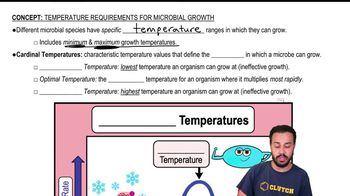
 04:16
04:16